Switzerland trivia: 47 questions and answers
The country at a glance
Which city is the seat of the Swiss parliament and government, officially called the 'federal city'?
- A. Bern
- B. Zurich
- C. Geneva
- D. Lucerne
Show the answer
Bern. Bern has been the federal city since 1848. Zurich is the largest city and Geneva is home to many international organisations.
The Swiss federal constitution names Bern as the capital of Switzerland.
True or false?
Show the answer
False. False. The constitution does not name a capital. Bern was chosen by parliament in 1848 as the federal city, the seat of government, and is the capital in practice.
How many national languages does Switzerland have?
- A. 2
- B. 3
- C. 4
- D. 5
Show the answer
4. 4: German, French, Italian and Romansh. Romansh is spoken in parts of the canton of Graubünden.
How many countries share a land border with Switzerland?
- A. 3
- B. 5
- C. 7
- D. 9
Show the answer
5. 5: Germany, France, Italy, Austria and Liechtenstein.
What is the highest mountain summit in Switzerland?
- A. Dufourspitze
- B. Matterhorn
- C. Jungfrau
- D. Eiger
Show the answer
Dufourspitze. The Dufourspitze, 4,634 m, in the Monte Rosa massif, is the highest. The Matterhorn is 4,478 m, the Jungfrau 4,158 m and the Eiger 3,967 m.
As of 2026, Switzerland is a member of the European Union.
True or false?
Show the answer
False. False. Switzerland is not in the EU. It works with the EU through bilateral agreements and has been part of the Schengen Area since 2008.
History
Which three Alpine communities made the alliance of 1291 that the Swiss see as the founding of their country?
- A. Uri, Schwyz and Unterwalden
- B. Zurich, Bern and Lucerne
- C. Geneva, Vaud and Valais
- D. Basel, Zug and Glarus
Show the answer
Uri, Schwyz and Unterwalden. Uri, Schwyz and Unterwalden made the Federal Charter in early August 1291. The others joined later.
On which date is Swiss National Day celebrated?
- A. 1 August
- B. 14 July
- C. 12 September
- D. 6 May
Show the answer
1 August. 1 August, inspired by the date of the Federal Charter of early August 1291.
In 1515, at Marignano near Milan, the Swiss were heavily defeated by the army of which king?
- A. Francis I of France
- B. Henry VIII of England
- C. Philip II of Spain
- D. Louis XIV of France
Show the answer
Francis I of France. Francis I of France, with Venetian allies, won the battle. It ended Swiss ambitions in Italy and is often seen as the start of Swiss neutrality.
Which reformer began preaching at the Grossmünster in Zurich in 1519, starting the Swiss Reformation?
- A. Huldrych Zwingli
- B. John Calvin
- C. Martin Luther
- D. Henry Dunant
Show the answer
Huldrych Zwingli. Huldrych Zwingli preached in Zurich. John Calvin came to Geneva in 1536, and Martin Luther worked in Germany.
The Sonderbund War of 1847, between federal troops and seven conservative Catholic cantons, lasted less than a month.
True or false?
Show the answer
True. True. It lasted from 3 to 29 November 1847, and fewer than 150 people were killed. The new federal constitution of 1848 followed.
Which Geneva businessman inspired the founding of the Red Cross in 1863 and won the first Nobel Peace Prize?
- A. Henry Dunant
- B. John Calvin
- C. Rodolphe Lindt
- D. Jean-Jacques Rousseau
Show the answer
Henry Dunant. Henry Dunant saw the wounded after the Battle of Solferino in 1859 and called for help for them. He shared the first Nobel Peace Prize in 1901.
Swiss women won the right to vote in national elections in 1971.
True or false?
Show the answer
True. True. Male voters approved it in February 1971, after rejecting it in 1959.
Food and drink
Raclette, melted cheese scraped onto potatoes, comes from which canton?
- A. Valais
- B. Ticino
- C. Zurich
- D. Basel-Stadt
Show the answer
Valais. Raclette comes from Valais, where melting cheese by the fire is recorded as early as 1574.
A classic 'moitié-moitié' (half-and-half) fondue is made with which two cheeses?
- A. Gruyère and Vacherin Fribourgeois
- B. Cheddar and Gouda
- C. Mozzarella and Parmesan
- D. Brie and Camembert
Show the answer
Gruyère and Vacherin Fribourgeois. Gruyère and Vacherin Fribourgeois, in equal parts, melted with white wine.
What is the 'Röstigraben', the 'rösti ditch'?
- A. The joking name for the language border between German- and French-speaking Switzerland
- B. A deep valley where potatoes are grown
- C. A frying pan used for rösti
- D. A mountain pass in Graubünden
Show the answer
The joking name for the language border between German- and French-speaking Switzerland. It is the joking name for the language border between German- and French-speaking Switzerland, because rösti is seen as a German-Swiss dish.
The Zurich doctor Maximilian Bircher-Benner created muesli around 1900 for the patients at his clinic.
True or false?
Show the answer
True. True. He served it at his clinic in Zurich, at first as a light evening meal rather than breakfast.
What is traditionally served on the side with Älplermagronen, the Alpine herders' macaroni?
- A. Apple sauce
- B. Mustard
- C. Chips
- D. Tomato ketchup
Show the answer
Apple sauce. Apple sauce, a sweet contrast to the pasta, potatoes, cream and cheese.
Who created milk chocolate in Vevey in 1875?
- A. Daniel Peter
- B. Rodolphe Lindt
- C. Theodor Tobler
- D. Maximilian Bircher-Benner
Show the answer
Daniel Peter. Daniel Peter, with help from his neighbour Henri Nestlé. Rodolphe Lindt invented conching in 1879, and Theodor Tobler co-created Toblerone in 1908.
Cities
Which is the largest city in Switzerland?
- A. Zurich
- B. Bern
- C. Basel
- D. Lausanne
Show the answer
Zurich. Zurich, with about 440,000 people. Geneva is second and Basel third.
Lugano is the capital of the canton of Ticino.
True or false?
Show the answer
False. False. Lugano is the largest city of Ticino, but the cantonal capital is Bellinzona.
Why do most visitors arrive in Zermatt by train?
- A. Petrol and diesel cars are not allowed in the village
- B. There is no road up the valley at all
- C. The village is on an island
- D. Cars are only allowed on Sundays
Show the answer
Petrol and diesel cars are not allowed in the village. Petrol and diesel cars are not allowed in the village, to protect the air and the views, so most people leave their car in Täsch and take the train.
Landmarks
The Matterhorn stands on the border between Switzerland and which other country?
- A. Italy
- B. France
- C. Austria
- D. Germany
Show the answer
Italy. Italy, where the mountain is called Cervino. The Swiss village below it is Zermatt.
In which year did Edward Whymper's party first reach the summit of the Matterhorn?
- A. 1865
- B. 1786
- C. 1912
- D. 1953
Show the answer
1865. In 1865, on 14 July. Four of the seven climbers died on the way down when a rope broke.
Which place has the highest railway station in Europe, at 3,454 m?
- A. Jungfraujoch
- B. Gornergrat
- C. Rigi
- D. Pilatus
Show the answer
Jungfraujoch. The Jungfraujoch station, reached by train since 1912. The Gornergrat railway above Zermatt tops out at 3,089 m.
A large part of the Chapel Bridge in Lucerne was destroyed by fire in 1993.
True or false?
Show the answer
True. True. The fire of 18 August 1993 destroyed much of the bridge and most of its paintings. It reopened in April 1994.
Which poet wrote 'The Prisoner of Chillon' in 1816, making the castle on Lake Geneva famous?
- A. Lord Byron
- B. William Shakespeare
- C. Johann Wolfgang von Goethe
- D. Victor Hugo
Show the answer
Lord Byron. Lord Byron wrote the poem after visiting the castle, telling the story of François Bonivard, a Geneva prior who was chained there.
As of 2026, Chillon Castle is a UNESCO World Heritage Site.
True or false?
Show the answer
False. False. Chillon is a Swiss heritage site of national importance, but not on the UNESCO list. The nearby Lavaux vineyard terraces are.
As of 2026, how many UNESCO World Heritage Sites does Switzerland have?
- A. 5
- B. 13
- C. 25
- D. 40
Show the answer
13. Switzerland has 13, including the Old City of Bern, the Abbey of St Gall, Lavaux and the Swiss Alps Jungfrau-Aletsch.
Fun facts
Besides Switzerland, which country has a square national flag?
- A. Vatican City
- B. Denmark
- C. Austria
- D. Japan
Show the answer
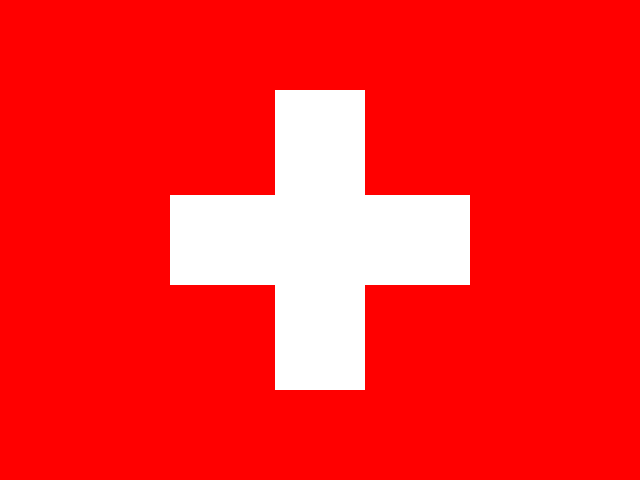
Vatican City. Vatican City is the only other country with a square national flag.
What gave the Swiss engineer George de Mestral the idea for Velcro in 1941?
- A. Burdock burrs stuck to his clothes and his dog's fur
- B. A bird's nest
- C. The scales of a fish
- D. A spider's web
Show the answer
Burdock burrs stuck to his clothes and his dog's fur. Burdock burrs stuck to his clothes and his dog's fur. Under a microscope he saw hundreds of tiny hooks.
What did Tim Berners-Lee invent at CERN, near Geneva, in 1989?
- A. The World Wide Web
- B. The mobile phone
- C. The Swiss Army knife
- D. The quartz watch
Show the answer
The World Wide Web. The World Wide Web. The first website went online in 1991.
In which Swiss city did Albert Einstein write his famous papers of 1905 while working at the patent office?
- A. Bern
- B. Basel
- C. Lugano
- D. St. Gallen
Show the answer
Bern. Bern. He lived in a flat on the Kramgasse from 1903 to 1905, which is now a small museum.
Since 1506, the Pontifical Swiss Guard has protected whom?
- A. The Pope
- B. The King of France
- C. The Swiss parliament
- D. The Red Cross
Show the answer
The Pope. The Pope, in Vatican City. Its guards are Swiss Catholic men.
As of 2026, the Gotthard Base Tunnel, opened in 2016, is the longest railway tunnel in the world.
True or false?
Show the answer
True. True. It is 57 km long and runs up to 2,450 m below the mountains.
Who wrote 'Heidi', the story of a girl living with her grandfather in the Swiss Alps?
- A. Johanna Spyri
- B. Hans Christian Andersen
- C. Lewis Carroll
- D. Astrid Lindgren
Show the answer
Johanna Spyri. Johanna Spyri, a Swiss writer, published it in 1880 and 1881.
Words
What does the Swiss German word 'Grüezi' mean?
- A. Hello
- B. Goodbye
- C. Thank you
- D. Cheers
Show the answer
Hello. Grüezi is a polite hello, from an old phrase meaning 'may God greet you'.
In Switzerland, what is a 'Velo'?
- A. A bicycle
- B. A train ticket
- C. A mobile phone
- D. A lake boat
Show the answer
A bicycle. A Velo is a bicycle. A train ticket is a Billett and a mobile phone is a Natel.
In Switzerland, German is written with 'ss' instead of the letter 'ß', so 'street' is spelled 'Strasse'.
True or false?
Show the answer
True. True. Swiss Standard German does not use ß, so you see Strasse and gross instead of Straße and groß.
Phrases
What do German-speaking Swiss say to each other before they start eating?
- A. En Guete!
- B. Uf Widerluege!
- C. Exgüsi!
- D. Grüezi!
Show the answer
En Guete!. En Guete! means enjoy your meal. Uf Widerluege is goodbye, Exgüsi is excuse me and Grüezi is hello.
'Uf Widerluege' is how you say hello when you walk into a shop in Zurich.
True or false?
Show the answer
False. False. Uf Widerluege means goodbye. On the way in you say Grüezi.
In which of these cities would you greet people with 'Bonjour'?
- A. Geneva
- B. Zurich
- C. Lugano
- D. St. Gallen
Show the answer
Geneva. Geneva is French-speaking. Zurich and St. Gallen speak German, and Lugano speaks Italian.
Local customs and tips
Which Swiss phone number is the direct line for an ambulance?
- A. 144
- B. 117
- C. 118
- D. 143
Show the answer
144. 144 is the ambulance. 117 is the police, 118 the fire brigade and 143 a helpline for people who need to talk. The European number 112 also works.
You may drive on Swiss motorways without buying a vignette, as long as you stay less than a week.
True or false?
Show the answer
False. False. Every car on the motorway needs a vignette, however short the stay. It costs 40 francs for the year.
In Swiss restaurants, service is included in the prices, so a tip is not required.
True or false?
Show the answer
True. True. Service has been included since 1974. Many people round up or leave up to about 10 percent for good service.
What does the Swiss Half Fare travelcard do?
- A. Roughly halves most train, bus and boat fares for a year
- B. Gives free travel on all trains for one day
- C. Lets you drive on motorways at half price
- D. Halves the price of hotel rooms
Show the answer
Roughly halves most train, bus and boat fares for a year. It roughly halves most train, bus and boat fares for a year. As of 2026, it costs 190 francs for the first year.
Where can you usually still find open shops on a Sunday in Switzerland?
- A. In large railway stations and airports
- B. In every village square
- C. Only in banks
- D. Nowhere: all shops are closed by law
Show the answer
In large railway stations and airports. In large railway stations and airports, and in some tourist areas. Most other shops are closed on Sundays.
Answer key
The country at a glance
- A. Bern
- False
- C. 4
- B. 5
- A. Dufourspitze
- False
History
- A. Uri, Schwyz and Unterwalden
- A. 1 August
- A. Francis I of France
- A. Huldrych Zwingli
- True
- A. Henry Dunant
- True
Food and drink
- A. Valais
- A. Gruyère and Vacherin Fribourgeois
- A. The joking name for the language border between German- and French-speaking Switzerland
- True
- A. Apple sauce
- A. Daniel Peter
Cities
- A. Zurich
- False
- A. Petrol and diesel cars are not allowed in the village
Landmarks
- A. Italy
- A. 1865
- A. Jungfraujoch
- True
- A. Lord Byron
- False
- B. 13
Fun facts
- A. Vatican City
- A. Burdock burrs stuck to his clothes and his dog's fur
- A. The World Wide Web
- A. Bern
- A. The Pope
- True
- A. Johanna Spyri
Words
- A. Hello
- A. A bicycle
- True
Phrases
- A. En Guete!
- False
- A. Geneva
Local customs and tips
- A. 144
- False
- True
- A. Roughly halves most train, bus and boat fares for a year
- A. In large railway stations and airports
More about Switzerland
- The trip to SwitzerlandMap, story, food, phrases and a friendly quiz.
- Switzerland word searchCities and dishes in large print.
- Swiss words crosswordLearn a few words while you solve it.
- Colour the flag of SwitzerlandPrint it or colour it in on the screen.
- Swiss rootsA family guide: history, recipes and words for the grandchildren.
- Before you goPhrases, customs and tips for travellers.
- Printable packLarge print, with a quiz and answers.