Nepal trivia: 46 questions and answers
The country at a glance
What is the capital of Nepal?
- A. Kathmandu
- B. Pokhara
- C. Lalitpur
- D. Bhaktapur
Show the answer
Kathmandu. Kathmandu, in the Kathmandu Valley at about 1,300 m, is the capital and largest city.
Which two countries share a land border with Nepal?
- A. China and India
- B. India and Bhutan
- C. China and Bangladesh
- D. India and Bangladesh
Show the answer
China and India. China and India are Nepal's only neighbours: China (Tibet) to the north and India on the other three sides. Bangladesh and Bhutan are close but do not touch Nepal.
What is the currency of Nepal?
- A. Nepalese rupee
- B. Nepalese taka
- C. Nepalese ngultrum
- D. Nepalese kyat
Show the answer
Nepalese rupee. The currency is the Nepalese rupee (NPR), introduced in 1932. The taka, ngultrum and kyat are the currencies of Bangladesh, Bhutan and Myanmar.
Nepal has a short coastline on the Bay of Bengal.
True or false?
Show the answer
False. False. Nepal is landlocked. The nearest sea, the Bay of Bengal, is several hundred kilometres away across India or Bangladesh.
In Nepal, traffic drives on the left side of the road.
True or false?
Show the answer
True. True. Nepal drives on the left, like its neighbour India.
History
Which king of Gorkha conquered the Kathmandu Valley in the 1760s and is honoured as the founder of modern Nepal?
- A. Prithvi Narayan Shah
- B. King Mahendra
- C. King Tribhuvan
- D. Yaksha Malla
Show the answer
Prithvi Narayan Shah. Prithvi Narayan Shah entered Kathmandu on 25 September 1768, during the Indra Jatra festival, and went on to unite many small states into one kingdom.
In which year did Nepal abolish its monarchy and become a republic?
- A. 2008
- B. 1990
- C. 2001
- D. 2015
Show the answer
2008. On 28 May 2008 the elected Constituent Assembly abolished the monarchy, about 240 years after the kingdom was founded.
Which treaty ended the Anglo-Nepalese War in 1816?
- A. Treaty of Sugauli
- B. Treaty of Titalia
- C. Treaty of Betrawati
- D. Treaty of Amritsar
Show the answer
Treaty of Sugauli. The Treaty of Sugauli, ratified in March 1816, ended the war with the East India Company. Nepal gave up recently conquered lands.
Nepal was a British colony until 1947.
True or false?
Show the answer
False. False. Nepal was never colonised. It fought a war with the British East India Company in 1814 to 1816 but stayed independent.
In April 2015 a major earthquake damaged or destroyed many old temples in the Kathmandu Valley.
True or false?
Show the answer
True. True. The earthquake of 25 April 2015, magnitude 7.8, killed nearly 9,000 people and badly damaged the valley's historic squares.
Food and drink
What is Nepal's everyday meal of rice with lentil soup called?
- A. Dal bhat
- B. Dhindo
- C. Momo
- D. Sel roti
Show the answer
Dal bhat. Dal bhat is rice (bhat) with lentil soup (dal), usually served with vegetable curry and pickle, twice a day.
What is dhindo, a staple of the hills and mountains?
- A. A stiff porridge of buckwheat, millet or maize flour
- B. A sweet ring of fried rice-flour batter
- C. A steamed dumpling with a meat filling
- D. A pickle of fermented leafy greens
Show the answer
A stiff porridge of buckwheat, millet or maize flour. Dhindo is a stiff porridge of buckwheat, millet or maize flour, stirred into boiling water and eaten in small balls dipped in soup.
Juju dhau, the 'king of yoghurt', is a speciality of which town?
- A. Bhaktapur
- B. Pokhara
- C. Janakpur
- D. Biratnagar
Show the answer
Bhaktapur. Juju dhau comes from Bhaktapur. It is a thick, creamy buffalo-milk yoghurt set in clay pots.
Kwati, a Newar festival soup, is made mainly from what?
- A. Nine kinds of sprouted beans
- B. Fermented bamboo shoots
- C. Grilled buffalo meat
- D. Rice-flour dough
Show the answer
Nine kinds of sprouted beans. Kwati is made from nine kinds of sprouted beans, soaked for three or four days and cooked with spices. It is eaten at Janai Purnima, usually in August.
Samay baji, the Newar festival platter, is built around which food?
- A. Beaten rice (chiura)
- B. Wheat noodles
- C. Steamed buns
- D. Cornmeal porridge
Show the answer
Beaten rice (chiura). Samay baji is built around beaten rice (chiura), with roasted soybeans, choila, bara, egg, ginger, greens and pickle.
Gundruk is made from leafy greens that are fermented and then dried in the sun.
True or false?
Show the answer
True. True. Mustard, radish and cauliflower leaves are fermented for about a week, then sun-dried, so they keep through the winter.
Sel roti is a savoury bread made from wheat flour.
True or false?
Show the answer
False. False. Sel roti is a sweet, ring-shaped bread made from rice-flour batter and fried in oil, above all for Dashain and Tihar.
Cities
Lalitpur, next to Kathmandu, is also widely known by which other name?
- A. Patan
- B. Bhadgaon
- C. Kantipur
- D. Bhairahawa
Show the answer
Patan. Lalitpur is also called Patan, and Yala in the Newar language. Bhadgaon is the old name of Bhaktapur, Kantipur of Kathmandu, and Bhairahawa of Siddharthanagar.
Birgunj is called the Gateway of Nepal because most of the country's trade with India passes through it.
True or false?
Show the answer
True. True. Birgunj is joined to the Indian town of Raxaul, and most of Nepal's trade with India crosses the border there.
Landmarks
Which hilltop stupa in Kathmandu is nicknamed the Monkey Temple?
- A. Swayambhunath
- B. Boudhanath
- C. Pashupatinath
- D. Janaki Mandir
Show the answer
Swayambhunath. Swayambhunath, on a hill west of Kathmandu, is home to troops of monkeys. The Buddha's eyes are painted on all four sides of its tower.
Pashupatinath Temple, on the Bagmati River, is dedicated to which Hindu god?
- A. Shiva
- B. Vishnu
- C. Brahma
- D. Ganesha
Show the answer
Shiva. Pashupatinath is dedicated to Shiva as Pashupati, lord of the animals. It is the holiest Hindu temple in Nepal.
According to Buddhist tradition, who was born at Lumbini?
- A. The Buddha
- B. Sita
- C. Prithvi Narayan Shah
- D. Araniko
Show the answer
The Buddha. The Buddha, Siddhartha Gautama, was born at Lumbini according to tradition, often dated around 563 BC. Hindus honour Janakpur as the birthplace of Sita.
Chitwan National Park is known for its one-horned rhinos and Bengal tigers.
True or false?
Show the answer
True. True. Chitwan, Nepal's first national park, holds most of the country's greater one-horned rhinos, as well as Bengal tigers.
Phewa Lake in Pokhara is a UNESCO World Heritage Site.
True or false?
Show the answer
False. False. As of September 2026, Nepal's four World Heritage Sites are the Kathmandu Valley, Lumbini, Sagarmatha National Park and Chitwan National Park.
Fun facts
What shape is the national flag of Nepal?
- A. Two stacked triangular pennants
- B. A square
- C. A rectangle
- D. A single triangle
Show the answer
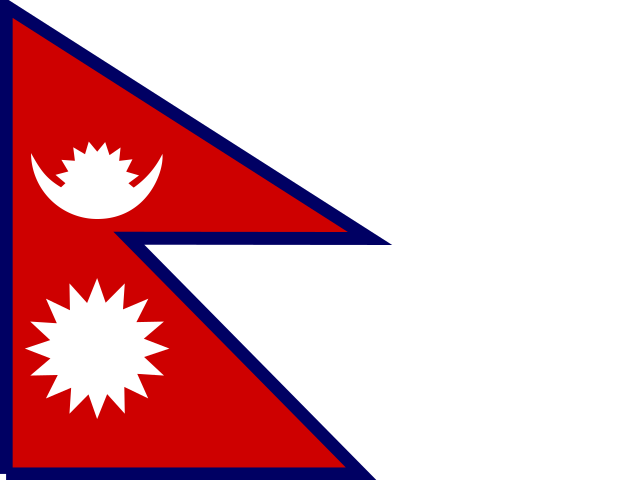
Two stacked triangular pennants. Nepal's flag is two stacked triangular pennants, crimson with a blue border. As of 2026 it is the only national flag that is not rectangular.
How far ahead of UTC are Nepal's clocks?
- A. 5 hours 45 minutes
- B. 5 hours 30 minutes
- C. 6 hours
- D. 5 hours
Show the answer
5 hours 45 minutes. Nepal Standard Time is 5 hours 45 minutes ahead of UTC, 15 minutes ahead of India.
What height for Mount Everest did Nepal and China announce after their joint survey in 2020?
- A. 8,848.86 m
- B. 8,611 m
- C. 8,586 m
- D. 8,091 m
Show the answer
8,848.86 m. The joint survey gave 8,848.86 m. The other figures are the heights of K2, Kangchenjunga and Annapurna I.
Nepal's official calendar, Bikram Sambat, runs about how many years ahead of the Western calendar?
- A. 57
- B. 12
- C. 30
- D. 78
Show the answer
57. Bikram Sambat runs about 57 years ahead. Its year 2083 began in April 2026.
Eight of the world's ten highest mountains stand in Nepal or on its borders.
True or false?
Show the answer
True. True. Everest, Kangchenjunga, Lhotse, Makalu, Cho Oyu, Dhaulagiri, Manaslu and Annapurna are all in Nepal or on its borders. Kangchenjunga is on the border with India, and Everest, Lhotse, Makalu and Cho Oyu on the border with China.
In the Kathmandu Valley a young girl is chosen and worshipped as the Kumari, a living goddess.
True or false?
Show the answer
True. True. The Royal Kumari of Kathmandu lives in the Kumari Ghar on Durbar Square, and there are other Kumaris in Patan and Bhaktapur.
Nepal's current banknotes show a portrait of the king.
True or false?
Show the answer
False. False. Since 2007 the banknotes have shown Mount Everest instead of the king, and Nepal became a republic in 2008.
The Newar artist Araniko designed the White Stupa in which city?
- A. Beijing
- B. Lhasa
- C. Delhi
- D. Kathmandu
Show the answer
Beijing. Araniko (1245 to 1306) designed the White Stupa of the Miaoying Temple in Beijing for the court of Kublai Khan.
Words
What does the Nepali word 'dhanyabad' mean?
- A. Thank you
- B. Hello
- C. Please
- D. Excuse me
Show the answer
Thank you. Dhanyabad means thank you. For hello, Nepalis say namaste.
Which Nepali word means water?
- A. pani
- B. chiya
- C. bhat
- D. masu
Show the answer
pani. Pani means water. Chiya is tea, bhat is cooked rice and masu is meat.
What does the Nepali word 'himal' mean?
- A. Snow mountain
- B. Lake
- C. River
- D. Village
Show the answer
Snow mountain. Himal means snow mountain. The northern mountain belt of Nepal is called the Himal, and a lake is a tal.
In Nepali, 'tal' means lake, as in Phewa Tal.
True or false?
Show the answer
True. True. Tal means lake, so Phewa Lake is Phewa Tal in Nepali.
Phrases
Your host offers you more dal bhat, but you are full. Which word says 'enough'?
- A. Pugyo
- B. Namaste
- C. Maaf garnus
- D. Pheri bhetaula
Show the answer
Pugyo. Pugyo means enough, I am full. Namaste is hello, maaf garnus is excuse me and pheri bhetaula is see you again.
How do you ask 'How much is this?' in Nepali?
- A. Yesko kati parchha?
- B. Mero naam ... ho
- C. Malai pani dinus
- D. Sanchai chhu
Show the answer
Yesko kati parchha?. Yesko kati parchha? asks the price. The others mean 'My name is', 'Please give me some water' and 'I am fine'.
Which greeting is the more formal one, used for an older or high-status person?
- A. Namaskar
- B. Pugyo
- C. Dhanyabad
- D. Mitho chha
Show the answer
Namaskar. Namaskar is the formal form of namaste, said with palms pressed together.
The Nepali phrase 'pheri bhetaula' means 'see you again'.
True or false?
Show the answer
True. True. Pheri bhetaula means see you again, and Nepalis use it when saying goodbye.
Local customs and tips
What is the official police emergency number in Nepal?
- A. 100
- B. 999
- C. 110
- D. 000
Show the answer
100. The police emergency number in Nepal is 100.
When does Nepal usually have the clearest air for mountain views?
- A. Autumn, October to December
- B. The monsoon, June to September
- C. Midsummer, July and August
Show the answer
Autumn, October to December. Autumn, October to December, has little dust in the air and is the best season for mountain views. The monsoon brings rain and clouds from June to September.
Which way should you walk around a Buddhist stupa?
- A. Keeping the stupa on your right
- B. Keeping the stupa on your left
- C. Whichever way is shorter
Show the answer
Keeping the stupa on your right. Walk clockwise, keeping the stupa on your right. The same goes for prayer walls and monasteries.
A common rule at high altitude is to sleep no more than about 300 m higher each night.
True or false?
Show the answer
True. True. Once you are above about 3,000 m, climbing slowly and taking rest days helps prevent altitude sickness.
Tap water in Nepal is generally safe to drink.
True or false?
Show the answer
False. False. Drink sealed bottled water, boiled water or water you treat yourself.
As of September 2026, foreign trekkers need a licensed guide in most of Nepal's national parks and conservation areas.
True or false?
Show the answer
True. True. The Nepal Tourism Board introduced the rule in April 2023. The Everest region has had its own local rules, so check before you book.
Answer key
The country at a glance
- A. Kathmandu
- A. China and India
- A. Nepalese rupee
- False
- True
History
- A. Prithvi Narayan Shah
- A. 2008
- A. Treaty of Sugauli
- False
- True
Food and drink
- A. Dal bhat
- A. A stiff porridge of buckwheat, millet or maize flour
- A. Bhaktapur
- A. Nine kinds of sprouted beans
- A. Beaten rice (chiura)
- True
- False
Cities
- A. Patan
- True
Landmarks
- A. Swayambhunath
- A. Shiva
- A. The Buddha
- True
- False
Fun facts
- A. Two stacked triangular pennants
- A. 5 hours 45 minutes
- A. 8,848.86 m
- A. 57
- True
- True
- False
- A. Beijing
Words
- A. Thank you
- A. pani
- A. Snow mountain
- True
Phrases
- A. Pugyo
- A. Yesko kati parchha?
- A. Namaskar
- True
Local customs and tips
- A. 100
- A. Autumn, October to December
- A. Keeping the stupa on your right
- True
- False
- True
More about Nepal
- The trip to NepalMap, story, food, phrases and a friendly quiz.
- Nepal word searchCities and dishes in large print.
- Nepalese words crosswordLearn a few words while you solve it.
- Nepalese rootsA family guide: history, recipes and words for the grandchildren.
- Before you goPhrases, customs and tips for travellers.
- Printable packLarge print, with a quiz and answers.