Greece trivia: 46 questions and answers
History
Which city-state's army defeated the Persians at the Battle of Marathon in 490 BC?
- A. Athens
- B. Sparta
- C. Corinth
- D. Thebes
Show the answer
Athens. Athens won at Marathon. The Spartans had been asked for help but arrived only after the battle.
Which Spartan king led the Greeks at the pass of Thermopylae in 480 BC?
- A. Leonidas
- B. Pericles
- C. Themistocles
- D. Alexander
Show the answer
Leonidas. King Leonidas of Sparta died holding the pass. Pericles and Themistocles were Athenian statesmen, and Alexander lived more than a century later.
Which philosopher tutored the young Alexander the Great?
- A. Socrates
- B. Plato
- C. Aristotle
- D. Pythagoras
Show the answer
Aristotle. Aristotle taught Alexander until he was 16. Socrates had died in 399 BC, long before Alexander was born in 356 BC.
Where were the first modern Olympic Games held, in 1896?
- A. Olympia
- B. Athens
- C. Paris
- D. London
Show the answer
Athens. The 1896 Games took place in Athens, with the Panathenaic Stadium as the main venue. The ancient Games had been held at Olympia.
In which year did the Ottoman Turks capture Constantinople, capital of the Byzantine Empire?
- A. 1389
- B. 1453
- C. 1571
- D. 1683
Show the answer
1453. Constantinople fell to the Ottomans on 29 May 1453, after a siege of 53 days.
On 28 October 1940 Greece rejected an ultimatum from Mussolini's Italy, and the date is now a national holiday.
True or false?
Show the answer
True. True. Greeks remember it as Ochi Day, 'No' Day, with parades every 28 October.
The marathon at the 1896 Athens Olympics was won by an American runner.
True or false?
Show the answer
False. False. It was won by Spyridon Louis, a Greek water carrier from Marousi, near Athens.
In a referendum in December 1974, a majority of Greeks voted to keep the monarchy.
True or false?
Show the answer
False. False. About 69% voted to abolish the monarchy, and Greece became a republic.
Food and drink
Tzatziki is a dip made of yogurt, garlic and which grated vegetable?
- A. Cucumber
- B. Carrot
- C. Beetroot
- D. Courgette
Show the answer
Cucumber. Tzatziki is strained yogurt with grated cucumber, garlic and olive oil, often with dill or mint.
Feta is made from sheep's milk, sometimes mixed with up to 30% of which other milk?
- A. Cow's milk
- B. Goat's milk
- C. Buffalo milk
- D. Camel milk
Show the answer
Goat's milk. Under its EU protection, feta is made from sheep's milk, or sheep's milk with up to 30% goat's milk.
A traditional Greek village salad, horiatiki, is made on a bed of lettuce.
True or false?
Show the answer
False. False. The Greek village salad is known for having no lettuce: just tomato, cucumber, onion, olives and feta.
According to the popular story, in which Greek city was the frappé, the foamy iced coffee, invented at a trade fair in 1957?
- A. Ioannina
- B. Thessaloniki
- C. Patras
- D. Heraklion
Show the answer
Thessaloniki. Thessaloniki. The story says a Nestlé employee first shook instant coffee with cold water and ice at the city's International Fair in 1957, though iced 'Nescafé frappé' may be a little older.
How is souvlaki cooked?
- A. Grilled on a skewer
- B. Boiled in broth
- C. Baked in filo pastry
- D. Fried in batter
Show the answer
Grilled on a skewer. Souvlaki is small pieces of meat grilled on a skewer. The name comes from 'souvla', a skewer.
Which flavour gives ouzo its taste?
- A. Anise
- B. Lemon
- C. Pine resin
- D. Honey
Show the answer
Anise. Ouzo is flavoured with anise, which is why it turns cloudy white when water is added. Pine resin is what flavours retsina wine.
The slow-roasted lamb dish kleftiko is named after the klephts, outlaws of the Ottoman period.
True or false?
Show the answer
True. True. The klephts are said to have cooked meat in covered pits so the smoke would not give them away.
Cities
Which town was the capital of modern Greece until Athens took over in 1834?
- A. Nafplio
- B. Thessaloniki
- C. Corfu
- D. Patras
Show the answer
Nafplio. Nafplio, in the Peloponnese, was the capital of the new Greek state until 1834, when King Otto moved the capital to Athens.
Which Greek city hosts one of Europe's largest carnivals every year?
- A. Patras
- B. Ioannina
- C. Kalambaka
- D. Nafplio
Show the answer
Patras. Patras holds one of Europe's largest carnivals, with huge satirical floats and parades.
Ioannina stands on the shore of Lake Pamvotis, in the mountains of Epirus.
True or false?
Show the answer
True. True. Ioannina lies at about 500 m above sea level on the western shore of Lake Pamvotis.
Landmarks
To which goddess was the Parthenon in Athens dedicated?
- A. Athena
- B. Aphrodite
- C. Hera
- D. Artemis
Show the answer
Athena. The Parthenon was the temple of Athena, the patron goddess of Athens.
Which ancient sanctuary did the Greeks believe was the centre, or 'navel', of the world?
- A. Delphi
- B. Olympia
- C. Epidaurus
- D. Knossos
Show the answer
Delphi. Delphi, home of Apollo's oracle, was marked as the navel of the world by a stone called the omphalos.
What makes the monasteries of Meteora so spectacular?
- A. They sit on top of huge rock pillars
- B. They are built inside a volcano crater
- C. They stand on a small island in a lake
- D. They are carved into sea cliffs
Show the answer
They sit on top of huge rock pillars. They sit on top of huge rock pillars of sandstone and conglomerate near Kalambaka, in Thessaly.
Which civilisation built the palace of Knossos on Crete?
- A. The Minoans
- B. The Romans
- C. The Byzantines
- D. The Ottomans
Show the answer
The Minoans. The Minoans built the first palace at Knossos around 1900 BC, long before the Romans, Byzantines or Ottomans.
The temple on the cliffs of Cape Sounion was dedicated to which god?
- A. Poseidon
- B. Zeus
- C. Apollo
- D. Hermes
Show the answer
Poseidon. Poseidon, god of the sea, had his temple at Sounion, looking out over the Aegean.
The ancient theatre of Epidaurus is famous for its acoustics and is still used for performances today.
True or false?
Show the answer
True. True. The theatre seats about 14,000 people, and plays are still staged there.
The White Tower of Thessaloniki was built by the ancient Romans.
True or false?
Show the answer
False. False. The Ottomans built it some time after they captured the city in 1430. Today it is a museum of the city's history.
Fun facts
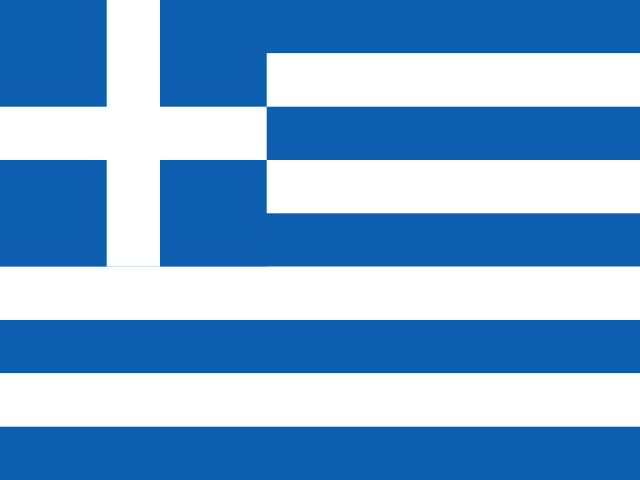
How many blue and white stripes does the Greek flag have?
- A. 7
- B. 9
- C. 11
- D. 13
Show the answer
9. The flag has 9 stripes, popularly said to match the nine syllables of 'Eleftheria i Thanatos', 'Freedom or Death'.
What does the Greek question mark look like?
- A. A semicolon (;)
- B. An exclamation mark (!)
- C. An upside-down question mark (¿)
- D. A colon (:)
Show the answer
A semicolon (;). In Greek the question mark looks just like a semicolon (;), as in 'Ti kánete;'.
Greece has thousands of islands. About how many of them are inhabited?
- A. About 20
- B. About 200
- C. About 1,200
- D. About 6,000
Show the answer
About 200. About 200: published counts range from 166 to 227 inhabited islands, out of between 1,200 and 6,000 islands in total, depending on the definition.
The Greek national anthem, the 'Hymn to Liberty', is also the national anthem of which other country?
- A. Cyprus
- B. Malta
- C. Albania
- D. Bulgaria
Show the answer
Cyprus. Cyprus adopted the Hymn to Liberty as its national anthem in 1966.
What is the Antikythera mechanism?
- A. An ancient Greek device of bronze gears that predicted eclipses
- B. A Venetian lock on the canal at Corinth
- C. A Byzantine water clock in Thessaloniki
- D. A Minoan loom found at Knossos
Show the answer
An ancient Greek device of bronze gears that predicted eclipses. It is an ancient Greek device of bronze gears that predicted eclipses. Found in a shipwreck in 1901, it is called the oldest known analogue computer.
Women are not allowed to enter the monastic community of Mount Athos.
True or false?
Show the answer
True. True. Greek law and religious tradition keep women out of the area governed by the monks of Mount Athos.
Greece has the longest coastline of any country on the Mediterranean.
True or false?
Show the answer
True. True. With its many islands and bays, Greece has about 13,700 km of coastline.
As of 2026, Mount Olympus is on the UNESCO World Heritage List.
True or false?
Show the answer
True. True. The wider area of Mount Olympus was added in July 2026, bringing Greece to 21 World Heritage Sites.
Words
What does 'efcharistó' (ευχαριστώ) mean?
- A. Thank you
- B. Please
- C. Good morning
- D. Goodbye
Show the answer
Thank you. Efcharistó means thank you. You may know the root from the English word 'Eucharist'.
In Greek, 'nai' (ναι) means 'no'.
True or false?
Show the answer
False. False. Nai means yes, even though it sounds like 'nay'. No is 'óchi'.
You want to pay at a taverna. Which word do you need?
- A. logariasmós
- B. leoforeío
- C. eisitírio
- D. farmakeío
Show the answer
logariasmós. Logariasmós is the bill. Leoforeío is a bus, eisitírio a ticket and farmakeío a pharmacy.
'Parakaló' (παρακαλώ) can mean both 'please' and 'you're welcome'.
True or false?
Show the answer
True. True. You say parakaló when asking for something, and also in reply to 'efcharistó'.
Phrases
What does 'Kaliméra' mean?
- A. Good morning
- B. Good night
- C. Cheers
- D. Excuse me
Show the answer
Good morning. Kaliméra means good morning. Good night is 'Kalinýchta'.
At a market stall, how do you ask 'How much is it?'
- A. Póso kánei?
- B. Ti kánete?
- C. Miláte angliká?
- D. Poú eínai i toualéta?
Show the answer
Póso kánei?. Póso kánei? means 'How much is it?'. Ti kánete? means 'How are you?'.
What does 'Den katalavaíno' mean?
- A. I don't understand
- B. I don't know
- C. I am sorry
- D. I would like
Show the answer
I don't understand. Den katalavaíno means I don't understand, useful when the conversation gets too fast.
'Geia sas' can be used both to say hello and to say goodbye.
True or false?
Show the answer
True. True. Geia sas works for both, and is the polite form. With friends, say 'Geia sou'.
Local customs and tips
In Greece, a small upward nod of the head with raised eyebrows usually means what?
- A. No
- B. Yes
- C. Hello
- D. Come here
Show the answer
No. It means no, often with a 'tsk' click of the tongue. A nod downwards means yes.
In Greece, pushing your open palm with spread fingers towards someone's face is a friendly greeting.
True or false?
Show the answer
False. False. This gesture, the moutza, is a traditional and strong insult in Greece.
On an Athens bus, when should you validate your ticket?
- A. When you board
- B. When you get off
- C. Only if an inspector asks
- D. At the end of the day
Show the answer
When you board. Validate it when you board buses, trolleybuses and trams. On the metro you tap in and out at the gates.
In Greece, causing a wildfire can be a criminal offence even if it was an accident.
True or false?
Show the answer
True. True. Causing a wildfire is a criminal offence in Greece even if unintentional, so never light fires outdoors in summer.
At the Meteora monasteries, shorts are fine for men as long as their shoulders are covered.
True or false?
Show the answer
False. False. Men are expected to wear long trousers, and women a skirt below the knee, with shoulders covered.
Answer key
History
- A. Athens
- A. Leonidas
- C. Aristotle
- B. Athens
- B. 1453
- True
- False
- False
Food and drink
- A. Cucumber
- B. Goat's milk
- False
- B. Thessaloniki
- A. Grilled on a skewer
- A. Anise
- True
Cities
- A. Nafplio
- A. Patras
- True
Landmarks
- A. Athena
- A. Delphi
- A. They sit on top of huge rock pillars
- A. The Minoans
- A. Poseidon
- True
- False
Fun facts
- B. 9
- A. A semicolon (;)
- B. About 200
- A. Cyprus
- A. An ancient Greek device of bronze gears that predicted eclipses
- True
- True
- True
Words
- A. Thank you
- False
- A. logariasmós
- True
Phrases
- A. Good morning
- A. Póso kánei?
- A. I don't understand
- True
Local customs and tips
- A. No
- False
- A. When you board
- True
- False
More about Greece
- The trip to GreeceMap, story, food, phrases and a friendly quiz.
- Greece word searchCities and dishes in large print.
- Greek words crosswordLearn a few words while you solve it.
- Colour the flag of GreecePrint it or colour it in on the screen.
- Greek rootsA family guide: history, recipes and words for the grandchildren.
- Before you goPhrases, customs and tips for travellers.
- Printable packLarge print, with a quiz and answers.