Emerald bays, busy motorbike cities, fragrant noodle soups and a long history, along a narrow S-shaped coast in Southeast Asia.
Vietnam stretches about 1,650 km from north to south along the eastern edge of mainland Southeast Asia, and at its narrowest it is only about 50 km wide. The Red River Delta in the north and the Mekong Delta in the south are wide, flat rice lands, joined by a long, mountainous central coast. The highest peak, Fansipan, rises in the far northwest.
For about a thousand years the north was ruled by Chinese dynasties, and after independence in the 10th century Vietnamese kingdoms slowly expanded south. France took control in the second half of the 1800s. The 20th century brought long wars, and the country was reunified in 1976, with Hanoi as its capital.
Questions to ask the older generation
Memories fade faster than photos. Ask these over a meal or a phone call, and write the answers down.
Which town or region of Vietnam did our family come from? Was it near Sa Pa, Ha Long, Ninh Binh?
Who was the first in the family to leave Vietnam, when, and why?
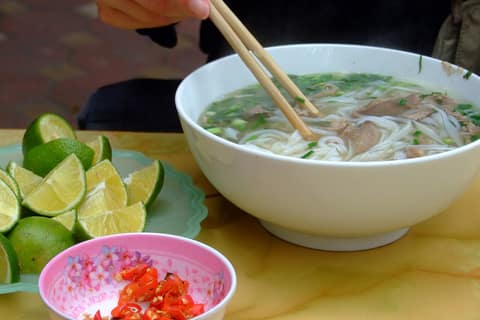
Which dishes from Vietnam were cooked at home? Did anyone make Phở or Bánh mì?
Does anyone in the family still speak Vietnamese, or use a few words of it?
Were there songs, prayers, games or holidays from Vietnam that the family kept?
Are there old photos, letters or documents from Vietnam? Who has them?
If you could visit Vietnam together, where would you go first?
A short history of Vietnam
Vietnamese tradition traces the nation back to the legendary Hùng kings and the Bronze Age Đông Sơn culture of the Red River Delta, famous for its great bronze drums. From 111 BC the north was ruled by Chinese dynasties for about a thousand years. After independence, Vietnamese kingdoms ruled from Thăng Long (Hanoi) and later Huế, until France took control in the 1800s. The 20th century brought independence, partition, war and, in 1976, reunification.
111 BC
The Han dynasty conquers the north
China's Han dynasty conquered the kingdom of Nanyue, which included the Red River Delta. It was the start of about a thousand years of Chinese rule over northern Vietnam, which brought Chinese writing and Confucian ideas. Buddhism arrived in the same centuries, by sea from India and overland from China.
AD 938
The Battle of Bạch Đằng
Ngô Quyền planted iron-tipped wooden stakes in the bed of the Bạch Đằng River. When the tide fell, the Southern Han fleet was caught on the stakes and destroyed. The victory ended Chinese rule, and Ngô Quyền became king the next year.
1288
The Mongol fleet is destroyed
During the third Mongol invasion, Prince Trần Hưng Đạo used the same trick as Ngô Quyền, with stakes hidden under the water of the Bạch Đằng River, and destroyed the Yuan fleet. It was the last Mongol invasion of Đại Việt.
1802
The Nguyễn dynasty begins
Nguyễn Ánh defeated his rivals, unified the country and became Emperor Gia Long. He made Huế the capital, and his dynasty, the last in Vietnamese history, lasted until 1945.
1945
Ho Chi Minh declares independence
On 2 September 1945 Ho Chi Minh read the Declaration of Independence of the Democratic Republic of Vietnam to a large crowd in what is now Ba Đình Square in Hanoi. 2 September is still Vietnam's National Day.
1965
US combat troops arrive
On 8 March 1965 about 3,500 US Marines landed near Da Nang, and the war between North and South Vietnam grew into a large international conflict. In Vietnam the war is known as the American War, or more formally the Resistance War against America.
1975
The war ends with the fall of Saigon
On 30 April 1975 North Vietnamese forces entered Saigon, the capital of South Vietnam, and the war ended. Estimates of Vietnamese soldiers and civilians who died in the war range from about 970,000 to 3 million, and more than 58,000 Americans died.
1986
The Đổi Mới reforms begin
In December 1986 the Communist Party launched Đổi Mới, 'renovation', opening the economy to private business and foreign trade. In 1995 Vietnam joined ASEAN and established diplomatic relations with the United States.