The first Balts arrive
Around 3000 BC the ancestors of the Latvians settled on the eastern shore of the Baltic Sea. Later they traded local amber with Rome and Byzantium for precious metals.
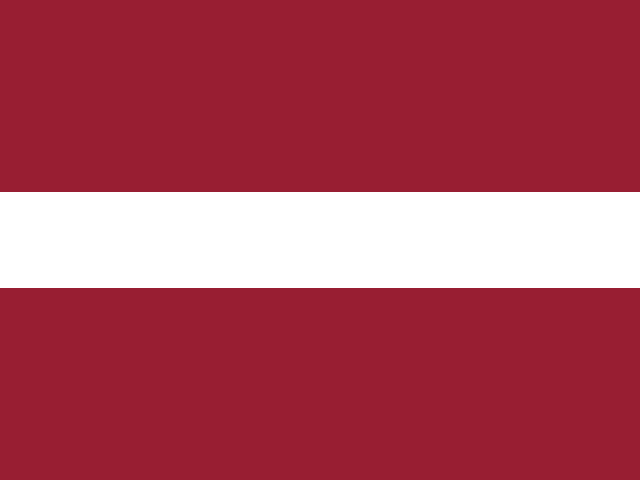
Latvia lies on the eastern shore of the Baltic Sea, between Estonia to the north and Lithuania to the south, with Russia and Belarus to the east. It is a flat, green country: most of the land is less than 100 metres above sea level, more than half of it is covered by forest, and it has about 500 km of sandy coast along the open sea and the shallow Gulf of Riga.
Baltic tribes and the Finnic Livonians lived here long before German crusaders arrived around 1200 and founded Riga. For the next seven centuries the land was ruled in turn by German knights, Poland and Lithuania, Sweden and Russia. Latvia declared independence on 18 November 1918, was occupied by the Soviet Union and Nazi Germany during the Second World War, and restored its independence in 1991 after the peaceful Singing Revolution.
Memories fade faster than photos. Ask these over a meal or a phone call, and write the answers down.
Latvia's story runs from amber traders and Baltic tribes, through German crusaders, the Hanseatic port of Riga and a duchy with colonies overseas, to independence in 1918, fifty years of occupation and a peaceful return to freedom in 1991.
Around 3000 BC the ancestors of the Latvians settled on the eastern shore of the Baltic Sea. Later they traded local amber with Rome and Byzantium for precious metals.
Riga became a member of the Hanseatic League, the great trading network of northern German towns, and later Cēsis, Valmiera and other Latvian towns joined too. Riga grew rich from east to west trade.
In a war between Poland and Sweden, Riga and much of northern Latvia came under Swedish rule. Riga became one of the largest cities in the Swedish Empire, and the Swedish period is remembered for schools for peasants.
During the Great Northern War, Russian troops took Riga, and plague killed about half of the city's people. By 1795 all of today's Latvia was part of the Russian Empire.
After two years of fighting against Soviet and German forces in the War of Independence, Latvia signed a peace treaty with Soviet Russia on 11 August 1920, which recognised its independence.
On 23 August 1989 about two million people joined hands in a human chain about 675 km long through Estonia, Latvia and Lithuania, to call for freedom from Soviet rule.
On 21 August 1991, as a coup attempt in Moscow failed, Latvia restored its full independence. Russian troops withdrew in 1994, apart from a radar station at Skrunda that closed in 1998.
On 1 January 2014 the euro replaced the lats, the Latvian currency first used between the two world wars and brought back in 1993. The same year Riga was a European Capital of Culture.
Cook one of the recipes, print the large-print pack about Latvia, and finish with the big-screen quiz or the words crossword. Grandchildren can colour the flag.