First settlers after the Ice Age
As the great ice sheet of the last Ice Age melted, people moved into the land around 9000 BC. For thousands of years they lived by hunting, fishing and gathering, and later by farming and trade around the Baltic Sea.
Finland is a Nordic country in the far north of Europe. It borders Sweden, Norway and Russia, with the Gulf of Bothnia to the west and the Gulf of Finland to the south, across from Estonia. It is a land of forests and water: about three quarters of the country is forest, and there are about 188,000 lakes larger than 500 square metres. A quarter of Finland lies north of the Arctic Circle, where the summer sun does not set for weeks and the long winter nights can bring the northern lights.
For more than five centuries, from the Middle Ages until 1809, Finland was part of the Kingdom of Sweden. It then became an autonomous Grand Duchy within the Russian Empire, and on 6 December 1917 it declared independence. During the Second World War Finland fought the Soviet Union twice, in the Winter War and the Continuation War. It lost land, but it kept its independence and its democracy.
Memories fade faster than photos. Ask these over a meal or a phone call, and write the answers down.
Finland's story runs from Stone Age hunters who followed the melting ice, through more than five centuries under Sweden and a century as a Grand Duchy of Russia, to independence, two hard wars and a modern European democracy.
As the great ice sheet of the last Ice Age melted, people moved into the land around 9000 BC. For thousands of years they lived by hunting, fishing and gathering, and later by farming and trade around the Baltic Sea.
Mikael Agricola, later Bishop of Turku, completed the first Finnish translation of the New Testament in 1548. There was no standard written Finnish at the time, so his books laid the foundations of Finnish spelling, and he is called the father of literary Finnish.
In the Finnish War of 1808 to 1809 Russia conquered Finland from Sweden. At the Diet of Porvoo in 1809, Emperor Alexander I promised to uphold Finland's laws and Lutheran faith. Finland became an autonomous Grand Duchy within the Russian Empire, and in 1860 it got its own currency, the markka.
On 28 February 1835 Elias Lönnrot published the Kalevala, a national epic he compiled from folk poems collected in Karelia and elsewhere. A longer version of 50 poems followed in 1849. It inspired Finnish artists and the growing national movement, and 28 February is Kalevala Day.
After the Russian Revolution, the Finnish Parliament approved the Declaration of Independence on 6 December 1917. Soviet Russia recognised it on 31 December 1917. 6 December is Finland's Independence Day.
On 30 November 1939 the Soviet Union invaded Finland. Finnish soldiers held out through the depths of winter until the Moscow Peace Treaty of 13 March 1940. Finland kept its independence but gave up about 9 percent of its territory, and about 420,000 people from the lost areas, mostly in Karelia, had to be resettled.
From 19 July to 3 August 1952 Helsinki hosted the Summer Olympic Games. Helsinki had agreed to take over the 1940 Games after Tokyo withdrew, but they were cancelled because of the war. Helsinki is still the most northerly city ever to host the Summer Olympics.
For decades Finland stayed militarily non-aligned. After Russia's full-scale invasion of Ukraine in 2022, public opinion changed quickly, and on 4 April 2023 Finland became the 31st member of NATO.
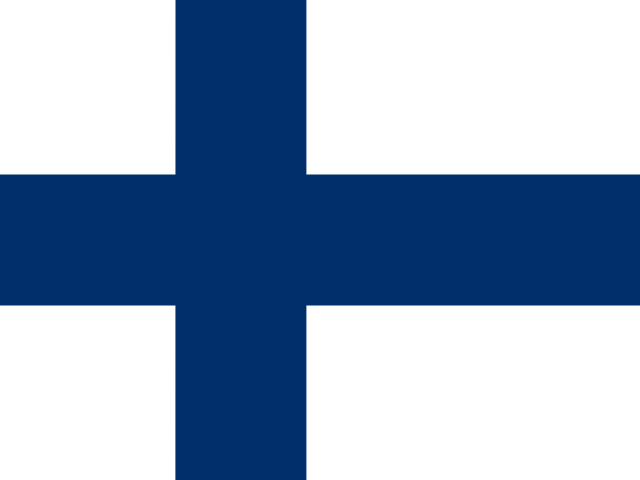
Cook one of the recipes, print the large-print pack about Finland, and finish with the big-screen quiz or the words crossword. Grandchildren can colour the flag.