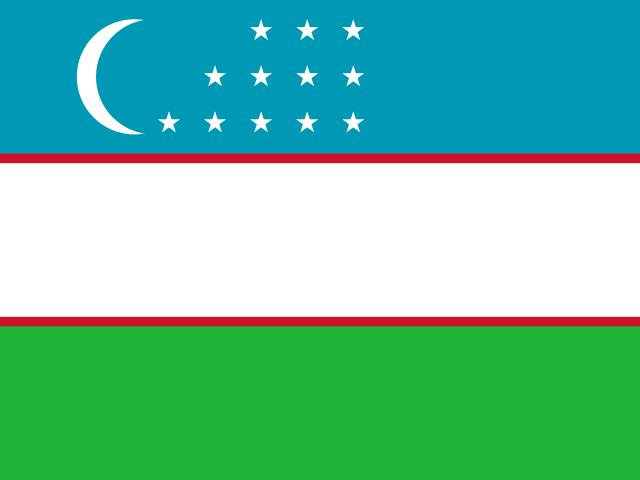
Learn Uzbekistan before you go
10 phrases to learn
In Uzbek (Latin alphabet). Capital letters show the stressed part. Tap the heart to practise a phrase later.
At the table
- Bread is treated with great respect. Do not waste it, and never throw it away where people can see.
- Take your shoes off when you enter a home. Guests are often seated on cushions around a low table or on a raised platform called a sori or tapchan.
- Tea is served in small bowls. The host fills yours only partly so it can be topped up often; a completely full bowl can be a hint that it is time to leave.
- Pass and accept dishes, bread and tea with your right hand: the left hand is considered unclean.
- Palov is usually served on one large platter placed in the middle of the table for everyone to share.
- Older people are shown great respect: let them sit first, serve them first and greet them first.
Local tips
Check the entry rules and keep your registration slips
As of September 2026 British visitors can stay up to 30 days without a visa; check the rules for your own nationality before you travel. Every visitor must be registered with the authorities within three days of arrival. Hotels do this for you, so ask for the registration slips and keep them, as border officers may ask to see them when you leave.
Carry your passport and some cash
By law you must carry your passport, and police do check. Cash machines that take foreign cards are mostly found in the big cities, so take out soʻm there before heading to smaller towns. Change money only at banks and official exchange offices: changing it on the street is illegal.
Take the fast train between the Silk Road cities
The Afrosiyob high-speed train links Tashkent with Samarkand in about two and a half hours and continues to Bukhara. Trains fill up quickly, so book ahead; tickets can be bought online up to 45 days in advance, and you need your passport.
Dress modestly at holy places
Uzbekistan is a secular country, but most people are Muslim. At mosques, mausoleums and shrines, cover your shoulders and knees, women should carry a scarf for their hair, and take your shoes off where others do. During Ramadan, be discreet about eating and drinking in public near mosques.
Ask before you take photos
Ask before photographing people, especially women and older people. Do not photograph police, soldiers, border posts, airports, bridges or government buildings. Taking pictures in the Tashkent Metro has been allowed since 2018, but staff may still ask you to stop.
Bring your medicines and their prescriptions
Some medicines that are common at home, such as those containing codeine, are controlled in Uzbekistan. Declare them on the customs form when you arrive, carry your prescriptions or a doctor's letter, keep medicines in their original packaging, and bring enough for the whole trip.
Choose spring or autumn and drink bottled water
Summers are very hot and dry, often around 40°C, and winters can be cold. April to early June and September to October are the most pleasant months for sightseeing. Drink bottled water, and outside Tashkent do not drink from the tap.
Bargain kindly at the bazaar
Prices in bazaars and souvenir shops are usually open to friendly bargaining, while prices in supermarkets and department stores are fixed. Carpets, art and some hotel rates are often quoted in US dollars, but you can pay in soʻm at the day's rate.
Dishes to try
- Palov (Palov, also called osh; plov in Russian): Uzbekistan's national dish: rice cooked in a large cauldron (qozon) on top of a rich base of mutton or beef, onions and thick strips of yellow and orange carrots, seasoned with cumin. Chickpeas, raisins, barberries or quince are added in some regions. It is served on a large platter for everyone to share.
- Somsa (Somsa; samsa in Russian): A savoury pastry, usually triangular or round, filled with minced or chopped lamb and plenty of onion, and baked on the hot inner wall of a clay tandir oven. There are versions with beef, chicken, potato or pumpkin, and bakers sell them hot from street stalls all day.
- Non (Non; obi non, Samarkand non): Round flatbread with a thick rim and a thin, patterned centre stamped with a special tool, baked on the walls of a clay tandir oven. It is served with every meal and treated with great respect. Every region has its own style of bread.
- Lagman (Lagʻmon): Long hand-pulled noodles with a sauce of lamb or beef, peppers, onions, tomatoes and other vegetables. It can be served as a thick soup or as a drier noodle dish with the sauce on top.
- Shivit oshi: The green noodles of Khorezm: dill is worked into the dough, which turns the noodles a pale green. They are served with a stew of meat and vegetables and a spoonful of suzma, a thick strained yoghurt.
- Norin (Norin; naryn in Russian): Thin sheets of boiled noodle dough and boiled meat, often horse meat or the horse-meat sausage called qazi, are chopped very finely by hand and mixed together. The dry version is served cold, and there is also a version with meat broth and onion.
- Manti: Large steamed dumplings filled with chopped lamb and onions, or with pumpkin. They are cooked in a tall steamer with several layers and served with yoghurt or sour cream and a sprinkle of pepper.
- Chuchvara: Small dumplings, a bit like tortellini, filled with minced meat and onion. They are boiled and served in a clear broth, or drained and topped with yoghurt.
Cities to see
- Tashkent (capital): The Tashkent Metro and its decorated stations, Chorsu Bazaar under its great blue dome, Amir Timur Square and the old town around the Khast Imam complex.
- Samarkand: The Registan square and its three madrasas, Timur's tomb, the Gur-e-Amir, Its round bread and the Siyob Bazaar.
- Bukhara: The Kalyan Minaret and the Po-i-Kalyan complex, The Ark fortress, Domed trading bazaars and the Lyabi-Hauz pool.
- Khiva: The mud-brick walls of Itchan Kala, The short, tiled Kalta Minor minaret, Green shivit oshi noodles.
- Nukus: The Savitsky Museum of Art, Karakalpak culture and crafts, The road to Moynaq and the Aral Sea.
- Moynaq: The rusting fishing boats of the ship graveyard, A small museum of the Aral Sea, The Stihia electronic music festival, held since 2018.