World Stroll
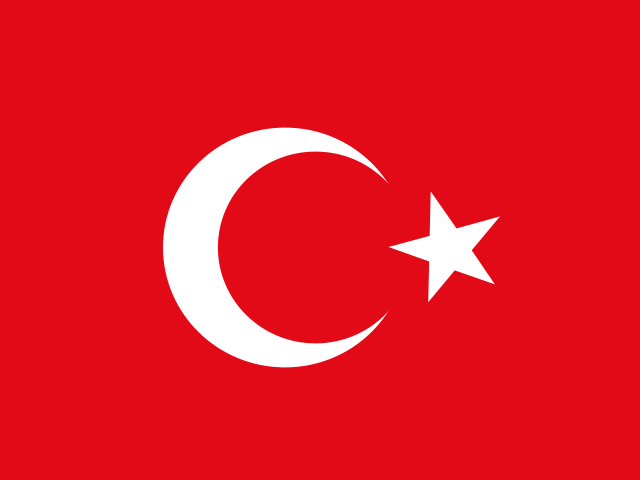
Flag of Türkiye
Travel guide

Learn Türkiye before you go

A country on two continents, where Istanbul's minarets rise over the Bosphorus and every visitor is offered a glass of tea.
Take the full trip
CapitalAnkara
CurrencyTurkish lira (TRY, symbol ₺), divided into 100 kuruş
Official languageTurkish, as set out in the constitution. Kurdish, Arabic and other languages are also spoken
Drives on theRight
Calling code+90

10 phrases to learn

In Turkish. Capital letters show the stressed part. Tap the heart to practise a phrase later.

Merhaba
MER-ha-ba
Hello
The everyday greeting, any time of day
Günaydın
gun-eye-DUHN
Good morning
Greeting someone in the morning
İyi akşamlar
ee-YEE ak-sham-LAR
Good evening
Greeting or saying goodbye in the evening
Nasılsınız?
NA-suhl-suh-nuhz
How are you? (polite)
Asking after someone you do not know well
İyiyim, teşekkürler
ee-YEE-yim, te-shek-kur-LER
I'm fine, thanks
Answering 'how are you?'
Benim adım ...
be-NIM a-DUHM
My name is ...
Introducing yourself
Teşekkür ederim
te-shek-KUR e-de-RIM
Thank you
Thanking someone politely
Affedersiniz
af-fe-DER-si-niz
Excuse me
Getting someone's attention or squeezing past
Kaç para?
KACH pa-ra
How much is it?
Asking a price in a shop or market
Çok pahalı
CHOK pa-ha-LUH
That's very expensive
Bargaining in the bazaar, with a smile

At the table

  • If you are invited to a Turkish home, bring a small gift such as flowers or sweets. Avoid wine unless you know your hosts drink, as many Turks do not drink alcohol.
  • Tea is offered everywhere: at home, in offices and even while you bargain in the bazaar. It is served in small tulip-shaped glasses, and accepting one is polite.
  • People say 'afiyet olsun', may it be good for you, to anyone who is eating, much like 'enjoy your meal'.
  • Take off your shoes just outside or inside the door when you enter a Turkish home, unless your hosts tell you to keep them on.
  • Blowing your nose or picking your teeth at the table is considered very rude; step away from the table instead.
  • Older people are served first and treated with great respect. During Ramadan, families and neighbours break the fast together at sunset with a meal called iftar.

Local tips

Visiting mosques

Take off your shoes at the entrance and carry them in the bags provided. Cover your shoulders and knees; women should also cover their hair, and scarves are often lent at the door. Avoid prayer times, especially Friday midday, and do not walk in front of people who are praying.

Be thoughtful during Ramadan

During Ramadan many Muslims fast from dawn to sunset. Visitors are not expected to fast, and restaurants in cities and resorts stay open, but eating, drinking or smoking in public in conservative areas is best avoided in the daytime.

Carry ID and respect national symbols

By law you must carry photo ID, so keep your passport with you at all times. It is a crime to insult the Turkish nation, the flag, Atatürk or the President, so avoid jokes about them. Do not photograph military sites.

Bargain with a smile

In bazaars such as Istanbul's Grand Bazaar, prices for carpets, lamps and souvenirs are open to bargaining. Take your time, accept the tea, and walk away politely if the price is not right. In ordinary shops and supermarkets prices are fixed.

Tipping

Tipping is not obligatory, but about 10 percent is common in restaurants if you are happy with the service; it is usually left in cash, as it often cannot be added to a card payment. Taxi drivers do not expect a tip, but people often let them keep the change. In a Turkish bath (hamam), about 10 percent is customary.

Getting around Istanbul

Trams, the metro and the ferries across the Bosphorus are cheap and easy. Buy a rechargeable Istanbulkart travel card from a machine at a metro station; up to five people can travel on one card, tapping it one after another. A ferry ride is one of the best views of the city.

In an emergency

As of 2026, the single emergency number in Türkiye for police, ambulance and fire is 112. Drink bottled water rather than tap water, and remember that Türkiye lies in an earthquake zone: follow the advice of local authorities.

Check the rules before you go

Entry rules depend on your passport, and some visitors need an e-visa bought in advance. As of 2026, for example, British citizens can visit without a visa for up to 90 days in any 180. Also read your government's travel advice: the UK's, for example, advises against all travel within 10 km of the border with Syria.

Dishes to try

  • Meze: A spread of small dishes to share at the start of a meal: white cheese, melon, yoghurt with garlic and cucumber (cacık), smoky aubergine purée, stuffed vine leaves, spicy tomato dip, and vegetables cooked in olive oil. In a meyhane, a traditional tavern, meze can last all evening.
  • Red lentil soup (Mercimek çorbası): A smooth, golden soup of red lentils, onion and carrot, finished with butter and red pepper and served with a wedge of lemon. It is found in almost every Turkish home and in simple restaurants called lokanta, and some people even eat it for breakfast.
  • Menemen: Eggs scrambled into a soft mixture of tomatoes, green peppers and olive oil, cooked and served in a small two-handled pan with plenty of bread for dipping. It is a favourite breakfast, and some cooks add sucuk, a spicy sausage, or white cheese.
  • Simit: A ring of bread dipped in water and molasses and covered in sesame seeds, then baked until crisp and golden outside and soft inside. Street sellers carry piles of simit on trays on their heads or sell them from trolleys, and many people eat one with tea and white cheese for breakfast.
  • Pide: Flatbread baked at a high heat, traditionally in a wood-fired oven, usually long, with the edges folded in around a filling of minced meat, cheese, egg or sucuk sausage. The Black Sea version, Karadeniz pidesi, is famous all over the country. The person who makes it is a pideci.
  • Lahmacun: A very thin round of dough spread with minced meat, onion, tomato, pepper and herbs, baked in a very hot oven for a few minutes. It has no cheese. You squeeze lemon over it, add parsley and onion, roll it up and eat it with your hands.
  • Adana kebab (Adana kebabı): Lamb minced by hand with tail fat and red pepper, pressed onto a wide flat iron skewer and grilled over charcoal. It is served with flatbread, grilled tomatoes and peppers, and onions with sumac. Kebabs vary greatly from region to region, and many cities are proud of their own.
  • İskender kebab (İskender kebap): Thin slices of meat grilled on a vertical spit, laid over pieces of flatbread, covered with hot tomato sauce and sizzling melted butter, and served with thick yoghurt on the side.

Cities to see

  • Istanbul: Hagia Sophia and the Blue Mosque, Topkapı Palace, The Grand Bazaar.
  • Ankara (capital): Anıtkabir, Atatürk's mausoleum, The Museum of Anatolian Civilizations, Ankara Castle.
  • İzmir: The Kordon seafront promenade, The Kemeraltı bazaar, The clock tower on Konak Square.
  • Bursa: İskender kebab, The Green Mosque and Green Tomb, Skiing on Mount Uludağ.
  • Antalya: The old town of Kaleiçi, Hadrian's Gate, Beaches and resorts.
  • Konya: The Mevlâna Museum, Whirling dervish ceremonies, Seljuk mosques and schools.

Landmarks and the city map are on the Türkiye trip