World Stroll
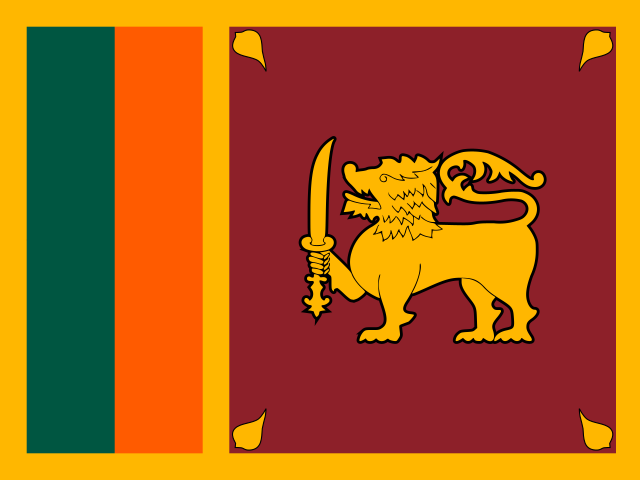
Flag of Sri Lanka
Travel guide

Learn Sri Lanka before you go

A teardrop-shaped island of tea hills, ancient Buddhist cities, golden beaches and wild elephants, where every meal starts with rice and a table full of curries.
Take the full trip
CapitalColombo
CurrencySri Lankan rupee (LKR)
Official languagesSinhala and Tamil. The constitution names English as the link language, and it is widely used in business and education
Drives on theLeft
Calling code+94

10 phrases to learn

In Sinhala, with two Tamil greetings. Capital letters show the stressed part. Tap the heart to practise a phrase later.

Āyubōwan
AH-yu-boh-wun
Hello, and also goodbye (literally 'may you live long')
The polite greeting at any time of day. Press your palms together in front of your chest and bow your head a little.
Kohomada?
KOH-hoh-muh-duh
How are you?
A friendly question after the greeting
Hondin innawa, sthūthiyi
HON-din IN-nuh-wuh, STOO-ti-yi
I'm fine, thank you
The answer to 'kohomada?'
Mage nama ...
MAH-geh NUH-muh ...
My name is ...
Introducing yourself
Sthūthiyi
STOO-ti-yi
Thank you
Thanking hosts, guides and shop staff
Karunākarala
kuh-roo-NAH-kuh-ruh-luh
Please
Making a polite request
Samāvenna
suh-MAH-wen-nuh
Excuse me, sorry
Asking someone's pardon or getting past in a crowd
Mata thērenne nǣ
MUH-tuh TAY-ren-neh NAA
I don't understand
When someone speaks too fast or you are lost
Mēka kīyada?
MAY-kuh KEE-yuh-duh
How much is this?
Shopping at a market or stall
Væsikiliya kohedha?
WA-si-ki-li-yuh KOH-heh-duh
Where is the toilet?
In a restaurant, station or temple

At the table

  • Most Sri Lankans eat rice and curry with the right hand, mixing a little rice with each curry using the fingertips. Every restaurant will bring a spoon and fork if you ask, but it is worth trying the local way.
  • Use your right hand to eat and to pass or receive food, money and gifts. The left hand is used for washing and is not used for eating.
  • Sri Lankan food can be very spicy. To ask for a milder dish, say 'særa aduwata', which means 'less strong'.
  • On Poya days, the full moon holiday each month, the sale of alcohol and meat is forbidden and many shops close, so plan ahead.
  • At the Sinhala and Tamil New Year in April, the first meal of kiribath is eaten at an auspicious time chosen by astrologers, and families visit each other with plates of kavum, kokis and other sweets.
  • Snack shops and bakeries sell 'short eats', such as patties, Chinese rolls and pastries, bought by the dozen for tea time, parties and journeys.

Local tips

Get your ETA before you fly

Most visitors need an Electronic Travel Authorization (ETA), Sri Lanka's form of visa, before arrival. As of September 2026, UK travel advice says it is valid for 30 days and that your passport must be valid for at least six months after you arrive. Apply only on the official government site, eta.gov.lk, not through look-alike agency sites.

Follow the monsoons

The southwest monsoon brings rain to the west coast, the south and the hill country from about May to September, and the northeast monsoon brings rain to the north and east from about November to March. So the west and south coasts are best from December to March, and the east coast from about April to September. The hills are coolest and clearest from January to March.

Respect the Buddha

At Buddhist temples, cover your shoulders and legs and take off your shoes and hat. Do not pose for photos with your back to a Buddha statue, and never touch or climb on statues. Disrespecting Buddhist images is a serious offence, and visitors with visible Buddha tattoos have been refused entry or deported.

Drink bottled water, and try king coconut

Tap water is not safe to drink. Buy sealed bottled water, and try thæmbili, the orange king coconut, which is cut open for you at roadside stalls and is very refreshing on a hot day.

Use an app for three-wheelers

Three-wheelers (tuk-tuks) are everywhere, but most have no meter. Agree on the fare before you get in, or book through a ride-hailing app such as PickMe or Uber, which show the price in advance.

Book the hill country train

The train from Kandy through Nuwara Eliya (Nanu Oya station) to Ella passes waterfalls, tea estates and forests and is one of the most popular train rides in the country. Reserved seats and observation cars on the popular tourist routes are often sold out days ahead in the high season, so book as early as you can.

Plan around Poya days

Every full moon day is a Poya holiday. Many shops close, and the sale of alcohol and meat is forbidden, so hotels and restaurants may not serve them. Temples are busy with worshippers dressed in white, which is lovely to see.

Keep your distance from wild elephants

Wild elephants live in national parks such as Yala, Udawalawe and Minneriya, and also cross roads outside them. Never get out of a vehicle near elephants, never feed them, and always follow your driver's or ranger's instructions.

Dishes to try

  • Rice and curry (Bath curry): The national everyday meal, eaten at lunch in homes, offices and roadside eateries. White or red rice is served with a spread of small curries: fish, chicken or beef, lentils, jackfruit, beans, pumpkin or aubergine, plus a sambol, a pickle and papadams. Each curry has its own colour and taste, from mild and creamy with coconut milk to dark, roasted and fiery.
  • Parippu (dhal curry) (Parippu): A mild, golden curry of red lentils cooked with turmeric, onion, green chilli and coconut milk, then finished with fried mustard seeds, curry leaves and onion. It is served with rice and curry, hoppers and bread, and is often the first curry children learn to love.
  • Pol sambol (Pol sambola): A fresh coconut relish of grated coconut, red onion, chilli, lime juice and salt, often with a pinch of Maldives fish, a smoked and dried tuna. It is bright red, spicy and sour, and appears beside rice, hoppers, string hoppers and bread at almost every meal.
  • Mallung (Mallum): Finely shredded green leaves, such as gotu kola, cassava leaves or water spinach, tossed briefly in a hot pan with grated coconut, shallots, green chilli, turmeric and a little Maldives fish. It is eaten at almost every rice and curry meal and is how many families get their daily greens.
  • Kiribath (milk rice) (Kiribath): Rice cooked in coconut milk until it sets, then flattened on a plate and cut into diamond shapes. It is eaten on the first day of each month and for every happy beginning: weddings, a new job, a new house and, above all, as the first meal of the Sinhala and Tamil New Year in April. It is served with lunu miris, a fiery onion and chilli paste, or with jaggery.
  • Hoppers and egg hoppers (Appa, biththara appa): Bowl-shaped pancakes made from a fermented batter of rice flour and coconut milk, cooked in a small round pan so that the edges are thin and crisp and the centre soft. For an egg hopper, an egg is cracked into the middle and cooks in the steam. Hoppers are eaten for breakfast or dinner with pol sambol, lunu miris and curry.
  • String hoppers (Indi appa, idiyappam): Small nests of thin rice-flour noodles, pressed through a mould onto little woven mats and steamed. They are eaten in stacks for breakfast or dinner with a thin coconut-milk curry called kiri hodi, a dhal curry and pol sambol.
  • Pittu (Pittu, puttu): Cylinders of rice or wheat flour layered with grated coconut and steamed in a bamboo or metal tube. Pittu is a favourite breakfast of Sri Lankan Tamils and is eaten with coconut milk, sambol and a spicy fish or chicken curry, crumbled and mixed together with the fingers.

Cities to see

  • Colombo (capital): Galle Face Green, a seafront park laid out in 1859, The busy markets of the Pettah, Gangaramaya Temple and the colonial buildings of the Fort district.
  • Negombo: Fishing boats and a busy fish market, Churches, giving it the nickname 'Little Rome', The Negombo Lagoon.
  • Kandy: The Temple of the Tooth Relic, The Esala Perahera procession with elephants in July and August, The Royal Botanic Gardens at Peradeniya.
  • Nuwara Eliya: High-grown tea and tea factories, Colonial buildings and a cool climate, Nearby Horton Plains and its World's End cliff.
  • Ella: The Nine Arch Bridge, Walks up Little Adam's Peak and Ella Rock, The hill country train ride.
  • Galle: Galle Fort and its ramparts, Dutch colonial streets and churches, Nearby beaches and whale watching at Mirissa.

Landmarks and the city map are on the Sri Lanka trip