World Stroll
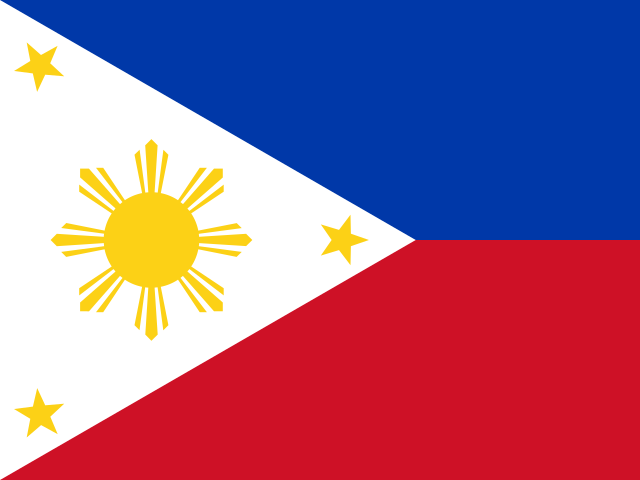
Flag of Philippines
Travel guide

Learn the Philippines before you go

More than seven thousand tropical islands, rice terraces carved into mountains, Spanish-era churches, warm hospitality and a respectful 'po' at the end of every polite sentence.
Take the full trip
CapitalManila
CurrencyPhilippine peso (₱)
Official languagesFilipino and English
Drives on theRight
Calling code+63

10 phrases to learn

In Filipino (Tagalog). Capital letters show the stressed part. Tap the heart to practise a phrase later.

Magandang umaga po
mah-gahn-DAHNG oo-MAH-gah poh
Good morning (polite)
In the morning, until about noon
Magandang hapon po
mah-gahn-DAHNG HAH-pohn poh
Good afternoon (polite)
From noon until dusk
Magandang gabi po
mah-gahn-DAHNG gah-BEE poh
Good evening (polite)
After dark
Kumusta po kayo?
koo-moos-TAH poh kah-YOH
How are you? (polite)
Greeting someone older or someone you do not know well
Mabuti naman po, salamat
mah-BOO-tee nah-MAHN poh, sah-LAH-maht
I'm fine, thank you
Answering 'How are you?'
Maraming salamat po
mah-RAH-ming sah-LAH-maht poh
Thank you very much
For a kindness, a meal or good service
Walang anuman
wah-LAHNG ah-noo-MAHN
You're welcome
When someone thanks you
Pasensya na po
pah-SEN-shah nah poh
Sorry, excuse me
Apologising, or asking someone to be patient
Ano po ang pangalan ninyo?
ah-NOH poh ahng pah-NGAH-lahn nin-YOH
What is your name? (polite)
Meeting someone
Ako si ...
ah-KOH see
I am ... / My name is ...
Introducing yourself

At the table

  • Wait until the host invites everyone to start, often with 'Kain tayo!' ('Let's eat!'). Filipinos also invite anyone who walks in during a meal to join, even if it is only politeness.
  • Eat with a spoon in the right hand and a fork in the left, using the fork to push food onto the spoon. Knives are rarely used at the table.
  • Take rice first, then small portions from the shared dishes with the serving spoon, and go back for more later rather than piling up your plate.
  • At a kamayan or 'boodle fight' feast, food is spread on banana leaves and eaten by hand: wash your hands first and push the food into your mouth with your thumb.
  • Offer food to elders first and let them start eating before you.
  • Many Filipinos in Mindanao and the Sulu islands are Muslim and do not eat pork, so check before bringing pork dishes to a shared meal.

Local tips

Add 'po' to be polite

Filipinos show respect by adding po to sentences and saying opo instead of oo for 'yes' when speaking to older people or strangers. Visitors are not expected to know this, but a 'salamat po' is always appreciated.

English goes a long way

English is an official language and is taught in schools, so signs, menus and many conversations are in English. People mix it freely with Filipino, a blend often called Taglish.

Plan around typhoon season

The dry season runs roughly from December to May. Typhoons are most common from July to October, when ferries and flights can be cancelled at short notice, so leave spare days when island-hopping and follow the PAGASA weather bulletins.

Jeepneys and tricycles

Jeepneys follow fixed routes painted on the side; pass your fare forward to the driver and say 'Para po!' to get off. Tricycles, motorbikes with sidecars, cover short trips in towns. Agree the fare before you ride, and carry small notes and coins.

Cash and small notes

The currency is the Philippine peso. Cards work in cities and malls, but markets, jeepneys, tricycles and small islands run on cash, and ATMs can be scarce away from towns.

Emergency number

As of 2026, the national emergency hotline is 911. It replaced the old 117 number in 2016 and connects to police, fire and ambulance services.

Dress for churches and heat

Cover shoulders and knees when visiting churches and mosques. Light cotton clothes, a hat and sun cream help in the tropical heat, and a light jacket is useful in air-conditioned buses and in cool Baguio.

Drink safe water

Drink bottled or filtered water rather than tap water, and be careful with ice from street stalls if you have a sensitive stomach.

Dishes to try

  • Chicken or pork adobo: Often called the unofficial national dish. Chicken or pork is simmered in vinegar, soy sauce, lots of garlic, bay leaves and black peppercorns until tender, then sometimes browned in the pan. The vinegar helped the dish keep well in the tropical heat, and it tastes even better the next day.
  • Sinigang: A sour soup, most often made with tamarind, with pork, prawns or fish and vegetables such as water spinach, radish, long beans, okra and tomato. The sourness is refreshing in the heat, and it is eaten with rice, often with a little fish sauce on the side.
  • Lechon: A whole pig roasted slowly over charcoal, turned by hand for hours until the skin is glassy and crisp. Lechon is the centrepiece of fiestas, weddings and Christmas. It is often served with lechon sauce, traditionally made from the roasted pig's liver, and many cooks stuff the pig with lemongrass, tamarind leaves and other herbs.
  • Kare-kare: Oxtail and beef stewed until soft in a thick, golden sauce of ground roasted peanuts and toasted rice, coloured with annatto seeds, with aubergine, long beans and pak choi. The sauce is mild, so it is always served with bagoong, a salty shrimp paste, on the side.
  • Sisig: Chopped pork from the pig's head and ears, boiled, grilled and then fried with onions, chilli and calamansi, served sizzling on a hot iron plate, often with an egg cracked on top. It is loved as a dish with rice or as a snack with a cold drink.
  • Chicken inasal (Inasal na manok): Chicken marinated in calamansi, coconut vinegar, black pepper and annatto, then grilled over hot coals and basted with the marinade, which gives it a golden orange colour. It is eaten with rice, a spoonful of chicken oil and a dip of soy sauce, calamansi and chilli vinegar.
  • Pinakbet: A vegetable stew of the Ilocano people: bitter melon, aubergine, okra, long beans and tomato, cooked gently with fermented fish sauce, sometimes with a little pork. The vegetables steam in their own juices and keep their shape.
  • Bicol express: Pork stewed in coconut milk with shrimp paste, garlic, ginger and plenty of chillies, until the sauce is thick and creamy. Bicol, the region of Mayon Volcano, is famous for cooking with coconut milk and chilli.

Cities to see

  • Vigan: Calle Crisologo and its old houses, Horse-drawn calesa rides, Vigan longganisa sausage and empanadas.
  • Banaue: Rice terraces, Ifugao culture and wood carving, Mountain walks to Batad.
  • Baguio: Cool mountain climate, Pine trees and flower gardens, Strawberries and the Panagbenga flower festival.
  • Quezon City: The largest city by population, The University of the Philippines, TV studios and big shopping malls.
  • Manila (capital): Intramuros, the old walled city, Sunsets over Manila Bay, Rizal Park and the Binondo Chinatown.
  • Legazpi: Views of Mayon Volcano, Spicy Bicolano food cooked in coconut milk, The gateway to Bicol.

Landmarks and the city map are on the Philippines trip