World Stroll
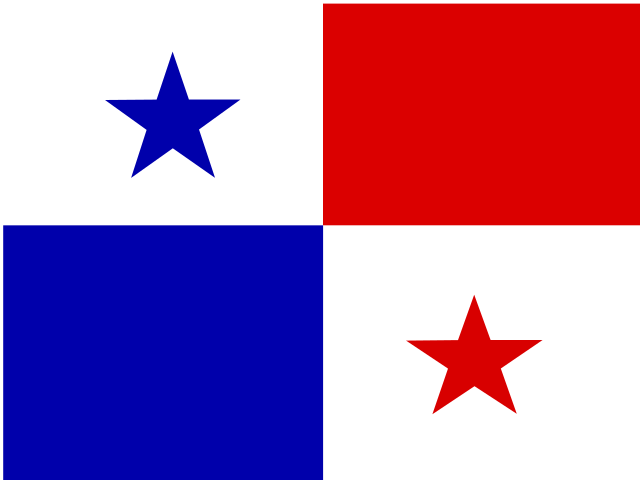
Flag of Panama
Travel guide

Learn Panama before you go

A narrow land bridge between two oceans, where ships climb over the hills through a famous canal, old forts guard the Caribbean shore, and rainforest begins just outside the capital.
Take the full trip
CapitalPanama City
CurrencyPanamanian balboa (PAB), fixed at one to one with the United States dollar, which is also legal tender. Panama mints its own coins, but all paper money is US dollars
Official languageSpanish. Many people in business and on the Caribbean coast also speak English, and Indigenous languages such as Ngäbere and Guna are spoken in their own territories
Drives on theRight. Panama drove on the left in the past and later switched
Calling code+507

10 phrases to learn

In Spanish (Panamanian). Capital letters show the stressed part. Tap the heart to practise a phrase later.

Buenos días
BWEH-nohs DEE-ahs
Good morning, hello
Greeting someone in the morning, until about noon
Buenas tardes
BWEH-nahs TAR-dehs
Good afternoon
Greeting someone from about noon until it gets dark
Buenas noches
BWEH-nahs NOH-chehs
Good evening, good night
Greeting someone after dark, or saying goodnight
¿Cómo está?
KOH-moh ehs-TAH
How are you?
A polite greeting to an adult you do not know well
Mucho gusto
MOO-choh GOOS-toh
Nice to meet you
When you are introduced to someone
Me llamo...
meh YAH-moh
My name is...
Introducing yourself
¿Habla inglés?
AH-blah een-GLEHS
Do you speak English?
Before asking for help. In Panama City many people speak some English
No entiendo
noh ehn-TYEHN-doh
I don't understand
When someone speaks too fast. Panamanians often drop the 's' at the end of words, so listen carefully
¿Me puede ayudar?
meh PWEH-deh ah-yoo-DAR
Can you help me?
Asking a stranger for help
¿Cuánto cuesta?
KWAHN-toh KWEHS-tah
How much is it?
Asking the price at a market or a craft stall

At the table

  • Lunch is the main meal of the day. In small family restaurants called fondas you get a full plate of rice, beans, meat and salad for a low price; if you are given a glass bottle of soda, hand the empty bottle back.
  • Panamanian food is not hot. If you like it spicy, ask for the hot sauce made with ají chombo peppers and add it yourself, a little at a time.
  • Try a chicha with your meal: a fresh fruit drink of tamarind, passion fruit, papaya or other fruits, or agua de pipa, the water of a young green coconut.
  • Panamanians dress neatly. Beachwear is fine at the beach, but in towns, and especially in banks and offices, long trousers or a skirt are expected.

Local tips

Come in the dry season if you can

Panama is warm all year, around 30 to 33°C by day on the coasts. The dry season, called verano (summer), runs from about December to April and is the most popular time to visit. In the rainy season, called invierno (winter), from about May to November, mornings are often sunny and the rain comes in the afternoon. The mountains around Boquete are cooler, so bring layers and a rain jacket.

Carry small US dollar notes

Panama uses US dollar notes, together with Panamanian coins that are the same size and value as US coins and are used alongside them. Many businesses will not accept 50 or 100 dollar notes, because of forgeries, so carry plenty of small notes. Outside the big towns, cards are not always accepted.

See the canal at work

The easiest place to watch ships is the visitor centre at the Miraflores Locks, a short taxi ride from central Panama City, with viewing terraces and a cinema. Ships pass through on a schedule during the day, so ask at the centre when the next big ones are expected. On the Caribbean side, near Colón, are the Gatún Locks and the newer, larger Agua Clara Locks.

Getting around

Panama City has a modern metro, opened in 2014, and city buses called MetroBus; both use the same rechargeable card, bought at the bigger stations. Long-distance buses leave from the Albrook terminal, next to a large shopping mall, and are cheap and frequent. Taxis usually have no meter, so agree the fare before you get in.

Respect Indigenous communities

Do not point at or photograph people in traditional dress without asking first, and use the names of the peoples: Guna, Emberá, Ngäbe and others. On the road to the Guna Yala islands, visitors pay an entry fee to the Guna territory, and on the islands most things, from hammocks to beaches, have a small charge.

Keep away from the Colombian border area

As of September 2026, the UK government advises that the area near the Colombian border, east of a line from Punta Carreto in Guna Yala through Yaviza to Punta Piña on the Pacific, should only be visited with an organised group and with the local police informed. The Darién jungle has no roads and is dangerous without guides.

Water, mosquitoes and health

Tap water is safe to drink in most towns, but drink bottled water in Bocas del Toro. Dengue, spread by mosquitoes, is a risk across the country, and there is some malaria in rural parts of Bocas del Toro, Darién and Guna Yala, so use insect repellent and check vaccine advice at least 8 weeks before you travel. Bring your regular medicines and good travel insurance.

Entry and documents

As of September 2026, British visitors arriving by air or land can stay up to 3 months without a visa. Border officers may ask for a return or onward ticket, your hotel address and proof of funds, such as about 1,000 US dollars or a credit card. Always carry a copy of your passport and of the entry stamp. Check the latest rules for your own nationality before you go.

Dishes to try

  • Ropa vieja: Beef that is simmered until soft, pulled into shreds and stewed with tomato, onion, sweet peppers and garlic. In Panama it comes on a plate with white rice, beans and a slice of fried ripe plantain.
  • Fried fish with coconut rice (Pescado frito con arroz con coco): A whole fish, seasoned and fried until the skin is crisp, served with rice cooked in coconut milk, patacones and a little cabbage and tomato salad. The fish market by the sea in Panama City, the Mercado de Mariscos, is a favourite place to eat it.
  • Patacones: Slices of green plantain fried, flattened and fried again until golden and crisp, then sprinkled with salt. They come with almost everything: fried fish, meat, ceviche, or simply on their own as a snack.
  • Ceviche (Ceviche de corvina): Small pieces of raw white fish, most often corvina (a kind of sea bass), 'cooked' in lime or lemon juice with chopped onion, celery, coriander and peppers. It is served cold as a starter, in a cup or in small pastry shells called canastitas, with crackers on the side. Shrimp and octopus ceviche are popular too.
  • Carimañolas: Torpedo-shaped fritters made from a dough of boiled, mashed yuca (cassava), filled with seasoned minced beef, chicken or cheese, and fried until golden and crisp. They are a favourite breakfast, often eaten with coffee.
  • Empanadas: Half-moon pastries made from wheat flour or corn dough, filled with meat, chicken, cheese or sometimes a sweet filling such as fruit jam or manjar blanco (milk caramel), and usually fried. They are sold at bakeries, street stalls and small kiosks.
  • Bollos: Rolls of ground corn dough wrapped tightly in leaves (corn husks, plantain leaves or palm leaves), tied with string and boiled. There are bollos of fresh young corn and of dried corn, and some are flavoured with butter or coconut or stuffed with beef.
  • Panamanian tortilla (Tortilla de maíz): A round of corn dough that is either cooked on a griddle or, in a smaller and thicker form about 10 cm across, fried until crisp outside and soft inside. With fresh white cheese, eggs or liver and onions it makes a classic Panamanian breakfast.

Cities to see

  • Panama City (capital): Casco Viejo, the old quarter, and the ruins of Panamá Viejo, The Miraflores Locks of the canal on the edge of the city, The Amador Causeway and Frank Gehry's colourful Biomuseo.
  • Colón: The Colón Free Trade Zone, a huge duty-free trading area opened in 1948, The Agua Clara and Gatún locks nearby, Fort San Lorenzo, west of the city.
  • Portobelo: Colonial forts and the old royal customs house, The Black Christ festival every 21 October, The Festival of Devils and Congos, Afro-Panamanian dances.
  • La Chorrera: Bollos and chicheme, Its yearly international fair, El Chorro waterfall.
  • Penonomé: A legend about the chief Nomé, who resisted the Spanish, The cathedral on the central square, Its position on the Pan-American Highway.
  • Santiago de Veraguas: A stop on the Pan-American Highway between Panama City and David, Shops, offices and schools for the whole of Veraguas province.

Landmarks and the city map are on the Panama trip