World Stroll
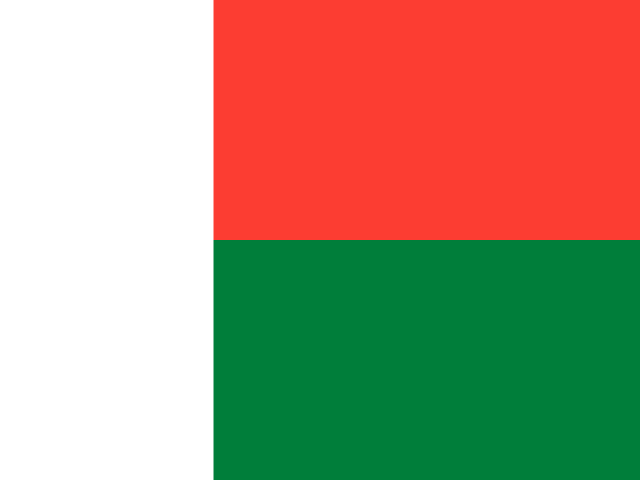
Flag of Madagascar
Travel guide

Learn Madagascar before you go

Lemurs leaping through the rainforest, giant baobabs at sunset, rice at every meal and a language that sailed here from Borneo, on the fourth-largest island in the world.
Take the full trip
CapitalAntananarivo
CurrencyMalagasy ariary (MGA)
Official languageMalagasy and French, as named in the 2010 constitution (suspended since October 2025)
Drives on theRight
Calling code+261

10 phrases to learn

In Malagasy (teny malagasy). Capital letters show the stressed part. Tap the heart to practise a phrase later.

Salama!
sah-LAHM
Hello!
A simple greeting at any time of day
Manao ahoana?
mah-NOW OWN
Hello, how are you?
The classic greeting in the highlands
Inona no vaovao?
EE-noo noo vow-VOW
What's new?
A friendly way to ask how someone is
Tsara be.
TSAR BAY
Very well (literally 'very good').
Replying when someone asks how you are
Misaotra betsaka.
mee-SOW-tch BET-sak
Thank you very much.
Thanking someone warmly
Azafady.
ah-zah-FAHD
Please; excuse me.
Asking for something or getting someone's attention
Veloma!
veh-LOOM
Goodbye!
Leaving
Tonga soa!
TOONG-uh SOO
Welcome!
What you will hear on arrival and see on signs
Inona ny anaranao?
EE-noo nee ah-nah-RAH-now
What is your name?
Meeting someone
Ohatrinona?
oo-ah-TCHEEN-oon
How much is it?
Shopping at a market

At the table

  • Rice is served in a large heap with the laoka and broth beside it. Spoon a little of the laoka and broth onto your rice rather than mixing everything at once.
  • Wait until the eldest person at the table has started eating before you begin. In towns people usually eat with a spoon; in the countryside meals are often eaten with the right hand.
  • Food taboos called fady differ from place to place and family to family: some people do not eat pork, others avoid certain animals. Ask before bringing food as a gift, and never press someone to eat something they refuse.
  • When opening a bottle of rum, many Malagasy pour the first drops into the northeast corner of the room for the ancestors. If your hosts do this, wait before drinking.
  • Say 'Mazotoa homana' ('enjoy your meal') before eating and 'Misaotra' ('thank you') afterwards.

Local tips

Drink safe water

Tap water is not safe to drink. Use bottled or treated water, and in simple eateries you can ask for ranon'apango, the rice water, which has been boiled. Be careful with salads and fruit you cannot peel.

Protect yourself from mosquitoes

Malaria is present in much of Madagascar, especially on the coasts. Ask your doctor about tablets well before you travel, sleep under a net and use a strong insect repellent from dusk.

Allow plenty of time on the roads

Most roads are slow, many are unpaved and some become impassable in the rainy season. A day for a few hundred kilometres is normal. Most visitors hire a car with a driver, and domestic flights save days on long trips.

Choose the dry season

The rainy season runs from about November to April and can bring cyclones, especially on the east coast. The dry season, from May to October, is the easiest time to travel, and the highland mornings can be chilly.

Respect fady and ask before photographs

Local taboos (fady) differ from place to place: they can forbid a food, a colour of clothing or swimming in a certain lake. Ask your guide what applies, never photograph a tomb without permission, and always ask before photographing people.

Show respect to elders

Add 'tompoko' (TOOM-pook), meaning sir or madam, when speaking to older people or officials. In a village, it is the custom to greet the head of the village first.

Carry small notes

The ariary comes in many notes, and change is often short. Carry small notes for markets and taxis, and bring some euros as a reserve, since cash machines in towns can be out of order.

Take a guide in the parks

In national parks such as Andasibe-Mantadia a local guide is required. Do not feed or touch the lemurs, stay on the paths and keep your voice low so you can hear the animals.

Dishes to try

  • Romazava: The national dish: a clear broth of zebu beef with several kinds of leafy greens, usually with tomato, onion and ginger, eaten with a big plate of rice. Its secret is brèdes mafana (paracress), whose leaves and yellow flowers make the tongue tingle and feel slightly numb.
  • Ravitoto sy henakisoa: Cassava leaves pounded in a wooden mortar until they are finely crushed, then slowly cooked with garlic and fatty pork until dark green and rich. It is served with rice and is one of the best-loved family dishes in the country.
  • Pork with white beans (Henakisoa sy tsaramaso): Pieces of pork simmered with white beans in a tomato, onion and garlic sauce. It is one of the most common laoka in family homes and in simple roadside eateries called hotely, always served with rice and often with a fresh tomato relish.
  • Fish in coconut sauce (Poisson au coco): Pieces of fresh fish gently cooked in coconut milk with onion, tomato, garlic and sometimes a little ginger or curry powder, then served with rice. On the coasts, coconut takes the place of the tomato sauces of the highlands.
  • Mi sao: Stir-fried egg noodles with vegetables and pieces of chicken, beef or pork, often topped with a boiled egg. It is a favourite in city snack bars and cheap restaurants.
  • Soupe chinoise: A big bowl of clear broth with noodles, pieces of meat or seafood, greens and often dumplings, seasoned with spring onion and a little chilli. It is eaten at any time of day, even at breakfast.
  • Zebu skewers (Masikita): Small pieces of zebu beef on thin sticks, grilled over charcoal with a little salt and sometimes garlic. The smoke from the braziers fills the streets in the evening, and the skewers are eaten on their own or with bread or rice.
  • Lasary: In the highlands, lasary is a crunchy salad of green beans, cabbage, carrot and onion in a vinegar dressing, served with rice or stuffed into a baguette. On the coast the same word is used for spicy fruit pickles.

Cities to see

  • Antananarivo (capital): The Rova, the royal palace complex on the highest hill, Lake Anosy with its jacaranda trees, Steep stairways and red-brick houses.
  • Toamasina: The largest port in Madagascar, Boulevard Joffre and colonial buildings, Soupe chinoise and seafood.
  • Antsirabe: Pousse-pousse rickshaws, Thermal springs, Crater lakes nearby.
  • Fianarantsoa: The old upper town on the hill, Wine from nearby vineyards, Tea plantations of Sahambavy.
  • Mahajanga: A huge old baobab tree in the town centre, The seafront promenade at sunset, Indian-influenced food such as khimo.
  • Toliara: The Coton de Tulear dog breed, Coral reef and beaches at Ifaty and Anakao, Spiny forest with baobabs and succulents.

Landmarks and the city map are on the Madagascar trip