World Stroll
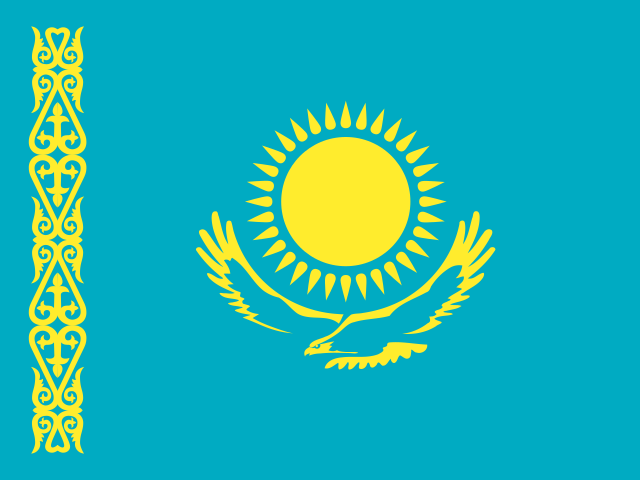
Flag of Kazakhstan
Travel guide

Learn Kazakhstan before you go

The world's largest landlocked country, where endless steppe meets snowy mountains, and every guest is welcomed with tea and warm fried bread.
Take the full trip
CapitalAstana
CurrencyKazakhstani tenge (KZT, symbol ₸), introduced on 15 November 1993
Official languageKazakh is the state language; Russian is also used officially, as set out in the constitution
Drives on theRight
Calling code+7, shared with Russia. The code +997 was reserved for Kazakhstan in 2021, but as of 2026 +7 is still used

10 phrases to learn

Capital letters show the stressed part. Tap the heart to practise a phrase later.

Сәлеметсіз бе? (Sälemetsız be?)
sah-leh-met-SIZ beh
Hello (polite)
Greeting anyone older than you or anyone you do not know
Сәлем (Sälem)
sah-LEM
Hi
Greeting friends and people your own age
Қалыңыз қалай? (Qalyñyz qalai?)
kha-luh-NUHZ kha-LIE
How are you?
Asking politely after someone's health
Рақмет, жақсы (Raqmet, jaqsy)
rakh-MET, zhakh-SUH
Fine, thank you
Answering 'How are you?'
Рақмет (Raqmet)
rakh-MET
Thank you
Any time you are given something or helped
Оқасы жоқ (Oqasy joq)
o-kha-SUH ZHOKH
You're welcome
Replying to thanks
Өтінем (Ötınem)
ur-tin-EM
Please
Asking for something politely
Кешіріңіз (Keşırıñız)
keh-shee-ree-NIZ
Excuse me, sorry
Getting someone's attention or apologising
Сау болыңыз (Sau bolyñyz)
SOW bo-luh-NUHZ
Goodbye
Leaving, literally 'stay healthy'
Қайырлы таң (Qaiyrly tañ)
kha-yur-LUH TAHNG
Good morning
Greeting someone in the morning

At the table

  • A guest is always given the place of honour at the table and a special welcome. Meals are traditionally laid out on a low table called a dastarkhan.
  • Tea is poured only part of the way up the bowl, called a kese. A small pour is a sign of respect, because the host will refill it again and again to keep your tea hot. A full bowl can hint that it is time to leave.
  • The host carves the meat for beshbarmak and hands out the best pieces to the most honoured guests and to children. The most honoured guest may be offered the boiled sheep's head to share out.
  • Tea comes with every meal, usually strong black tea with milk, and a festive meal often ends with kymyz and then more tea.
  • Vegetarians should ask before ordering: even dishes without meat are very often cooked in meat stock.

Local tips

Check the visa rules

As of September 2026, visitors from the UK and many other countries can stay without a visa for up to 30 days at a time, and no more than 90 days in any 180. Your passport needs at least 30 days of validity beyond arrival and a blank page. Rules change, so check official advice before you travel.

Carry your passport

You must carry your original passport or ID at all times; police may ask for it, and copies are not accepted. Hotels register foreign guests with the authorities within three working days, so keep your papers ready at check-in.

Plan for huge distances

Kazakhstan is enormous: Almaty and Astana are nearly 1,000 km apart in a straight line. Domestic flights save time, and a daily express train runs between Astana and Almaty.

Dress for the season

Summers are hot and dry, but winters are severe, especially in Astana, where minus 30 to minus 35 °C is common from mid-December to early March. Pack for the season you travel in.

Take care with photographs

Do not photograph military sites, border areas, airports or some government buildings; equipment can be confiscated. Some places, including the town of Baikonur, need special permission to visit.

Use booked taxis

Order taxis through an app or your hotel rather than stopping cars in the street, to avoid overcharging and unlicensed drivers.

Know the emergency numbers

The general emergency number is 112. You can also call 101 for fire, 102 for police and 103 for an ambulance. Almaty lies in an active earthquake zone, so note the safety instructions in your hotel.

Learn a few words of Kazakh

Russian is spoken almost everywhere, especially in cities, but a simple 'sälemetsız be' and 'raqmet' in Kazakh will earn you warm smiles.

Dishes to try

  • Beshbarmak (Бесбармақ (besbarmaq), also simply ет (et, 'meat')): Large pieces of boiled mutton or horse meat, often with horse sausage, served on a wide platter over sheets of thin boiled dough and topped with onions softened in the rich broth. The broth itself, sorpa, is drunk from bowls alongside. The name means 'five fingers', because it was traditionally eaten with the hands.
  • Kazy (Қазы (qazy)): A handmade sausage of horse meat and fat, dried or smoked and then boiled. It is sliced into rounds, each with a ring of white fat, and served cold as a starter with other cold meats, or cooked together with beshbarmak on festive days.
  • Kuyrdak (Қуырдақ (quyrdaq)): A hearty dish of fried meat and offal, such as liver, heart and kidneys, cut small and cooked with onions in a cauldron. Nomads traditionally made it from a freshly slaughtered sheep, frying it in animal fat; potatoes, which reached the region in the 19th century, are often added today.
  • Manty (Мәнті (mänti)): Large steamed dumplings filled with minced lamb or beef, onion and black pepper, sometimes with pumpkin. They are cooked in a tall steamer with several tiers and served with butter, sour cream or an onion sauce.
  • Laghman (Лағман (lağman)): Long, hand-pulled wheat noodles topped with a stir-fried sauce of meat, peppers, tomatoes, onion and garlic. In Kazakhstan it is known as a national dish of the Uyghur and Dungan communities, and it is found in cafés all over the country.
  • Nauryz kozhe (Наурыз көже (nauryz köje)): A thick soup made once a year for Nauryz, the spring new year in March. It is cooked from seven ingredients, which vary by region but usually include meat, fat, water, milk, grain and salt. The seven ingredients stand for good fortune and plenty in the coming year.
  • Baursak (Бауырсақ (bauyrsaq)): Small puffy pieces of fried dough, golden outside and soft inside, piled high on every dastarkhan. They are eaten with tea, butter, honey or jam, and a family gathering without baursak is hard to imagine.
  • Shelpek (Шелпек (şelpek)): A thin, round flatbread fried in oil in a shallow pan, soft and slightly chewy. It is eaten with tea and is also made for gatherings in memory of the dead.

Cities to see

  • Astana (capital): The Baiterek tower, Khan Shatyr, a giant transparent tent, Very cold winters.
  • Almaty: Mountain views and the Medeu skating rink, The wooden Ascension Cathedral, Aport apples.
  • Shymkent: Silk Road history, Markets and southern food, A gateway to Turkistan.
  • Karaganda: Coal mining, Soviet-era architecture, Central steppe landscape.
  • Aktobe: Oil and gas, Metal industry, Gateway to the western steppe.
  • Turkistan: The Mausoleum of Khoja Ahmed Yasawi, Pilgrimage, The ruins of nearby Otrar.

Landmarks and the city map are on the Kazakhstan trip