World Stroll
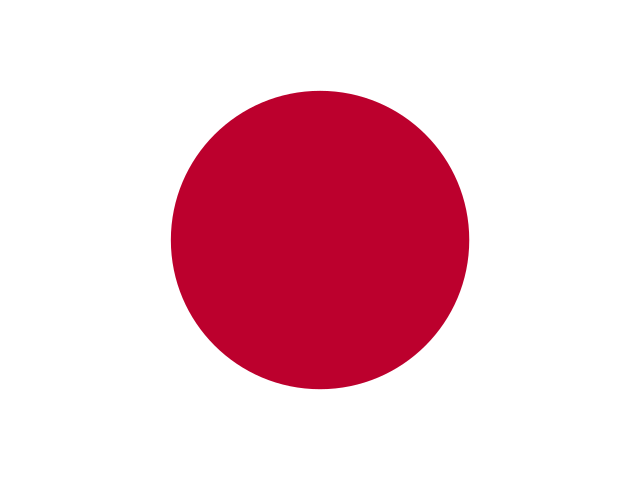
Flag of Japan
Travel guide

Learn Japan before you go

Ancient temples, snow-capped Mount Fuji and bullet trains, on a long chain of islands known as the Land of the Rising Sun.
Take the full trip
CapitalTokyo
CurrencyJapanese yen (¥)
Official languageNone by law; Japanese in practice
Drives on theLeft
Calling code+81

10 phrases to learn

In Japanese. Capital letters show the stressed part. Tap the heart to practise a phrase later.

Ohayō gozaimasu (おはようございます)
oh-HIGH-yoh goh-ZAI-mahs
Good morning
Greeting someone in the morning
Konnichiwa (こんにちは)
kohn-NEE-chee-wah
Hello, good afternoon
Greeting someone during the day
Konbanwa (こんばんは)
kohn-BAHN-wah
Good evening
Greeting someone in the evening
Hajimemashite (はじめまして)
hah-jee-meh-MAHSH-teh
Nice to meet you
Meeting someone for the first time, often with a bow
Arigatō gozaimasu (ありがとうございます)
ah-ree-GAH-toh goh-ZAI-mahs
Thank you very much
The polite thank you, for shop staff, hosts and strangers
Sumimasen (すみません)
soo-mee-MAH-sen
Excuse me
Calling a waiter, getting past someone or saying sorry
Onegaishimasu (お願いします)
oh-neh-GUY-shee-mahs
Please
Asking for something, for example after naming what you want
Kore o kudasai (これをください)
KOH-reh oh koo-DAH-sai
This one, please
Pointing at something in a shop or on a menu
Ikura desu ka? (いくらですか)
ee-KOO-rah DEHS-kah
How much is it?
Asking a price
Toire wa doko desu ka? (トイレはどこですか)
TOY-reh wah DOH-koh DEHS-kah
Where is the toilet?
Looking for the toilet

At the table

  • Say 'itadakimasu' before you eat and 'gochisōsama deshita' when you finish, to thank everyone who made the meal.
  • Never stand your chopsticks upright in a bowl of rice, and never pass food from your chopsticks to someone else's. Both are linked with funerals.
  • Slurping noodles such as ramen and soba is normal, and shows you are enjoying them.
  • It is fine to lift a small bowl of rice or soup close to your mouth.
  • With nigiri sushi, dip the fish side lightly in soy sauce, not the rice.
  • Tipping is not customary in restaurants. Good service is simply part of the price.

Local tips

Carry some cash

Cards are accepted more and more, but many small shops, restaurants and even hotels, especially in the countryside, take only cash. ATMs at post offices and 7-Eleven stores accept foreign cards.

Do not tip

Tipping is not customary in restaurants, taxis or hotels, and it can cause confusion. Good service is part of the price.

Take your shoes off

Remove your shoes in homes, traditional inns, many temples and restaurants with tatami mats. Wear socks without holes and shoes that slip on and off easily.

Get an IC card

Rechargeable cards such as Suica, PASMO and ICOCA work on trains and buses across the country, and in many shops and vending machines. Tap in and out at the gates.

Keep quiet on trains

Do not talk on your phone on trains or buses; a quiet conversation is fine. Priority seats are for older, pregnant and disabled passengers.

Queue at the train doors

People line up at the marked spots on the platform and wait at the sides of the doors until everyone has got off.

Onsen etiquette

At hot spring baths, wash and rinse your whole body at the showers before getting in. Bathing is done naked, in separate baths for men and women, and some baths turn away people with tattoos.

Bow rather than hug

A small bow is the usual greeting. Hugs and kisses are rare in public, and a handshake is fine with people used to foreigners.

Dishes to try

  • Sushi (寿司): Rice seasoned with vinegar, topped or rolled with fish, seafood, egg or vegetables. The best-known kind, nigiri, is a small hand-pressed block of rice with a slice of fish on top.
  • Ramen (ラーメン): Wheat noodles in a rich broth flavoured with soy sauce, salt, miso or pork bones, topped with sliced pork, a soft-boiled egg, spring onions and seaweed.
  • Tempura (天ぷら): Prawns, fish and vegetables dipped in a very light, cold batter and fried until crisp, served with a dipping sauce and grated radish.
  • Miso soup (味噌汁): A simple soup of dashi stock and miso, a paste of fermented soybeans, usually with tofu, seaweed and spring onions. It is served with almost every traditional meal, even breakfast.
  • Onigiri (rice balls) (おにぎり): Triangles or balls of rice with a filling such as salted salmon, pickled plum or tuna, wrapped in a strip of nori seaweed. They are the classic picnic and lunchbox food, sold in every convenience store.
  • Okonomiyaki (お好み焼き): A thick savoury pancake of batter and shredded cabbage with pork or seafood, cooked on a hot plate and topped with a sweet brown sauce, mayonnaise, seaweed flakes and dried bonito. The name means 'grilled as you like it'.
  • Takoyaki (たこ焼き): Round balls of batter with a piece of octopus inside, cooked in a special pan with half-round moulds and topped with sauce, mayonnaise, seaweed and bonito flakes.
  • Chicken teriyaki (照り焼きチキン): Chicken pan-fried and glazed with soy sauce, mirin and sugar. 'Teri' means shine and 'yaki' means grilled, for the glossy sauce.

Cities to see

  • Tokyo (capital): The Imperial Palace, Sensō-ji temple in Asakusa, Tokyo Skytree.
  • Yokohama: Japan's largest Chinatown, The Minato Mirai waterfront, The first railway, to Tokyo, in 1872.
  • Nagoya: Nagoya Castle and its golden roof fish, The car industry, Miso katsu, pork cutlet with miso sauce.
  • Kanazawa: Kenroku-en garden, Gold leaf, The Higashi Chaya geisha district.
  • Kyoto: The Golden Pavilion, Fushimi Inari's red gates, Geisha in the Gion district.
  • Osaka: Takoyaki and okonomiyaki, Osaka Castle, The neon lights of Dōtonbori.

Landmarks and the city map are on the Japan trip