World Stroll
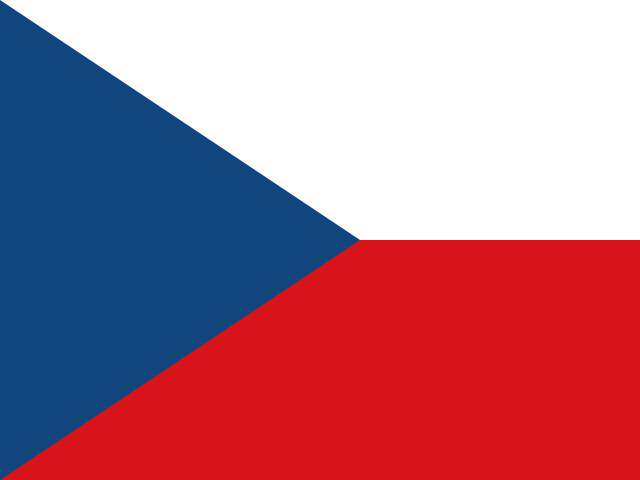
Flag of Czechia
Travel guide

Learn Czechia before you go

A green, hilly land in the heart of Europe, with fairy-tale castles, a capital of a hundred spires, spa towns and the world's first golden lager.
Take the full trip
CapitalPrague
CurrencyCzech koruna (Kč), since 1993
Official languageCzech in practice; the constitution does not name an official language
Drives on theRight
Calling code+420

10 phrases to learn

In Czech. Capital letters show the stressed part. Tap the heart to practise a phrase later.

Dobrý den
DOH-bree dehn
Hello, good day
The polite greeting for most of the day, in shops and with strangers
Dobré ráno
DOH-breh RAH-noh
Good morning
Early in the morning
Dobrý večer
DOH-bree VEH-chehr
Good evening
Greeting someone in the evening
Dobrou noc
DOH-broh nohts
Good night
When going to bed or leaving late at night
Na shledanou
NAHS-kleh-dah-noh
Goodbye
The polite way to say goodbye, for example when leaving a shop
Jak se máte?
yahk seh MAH-teh
How are you? (polite)
Asking someone you know how they are. Czechs expect a real answer
Dobře, děkuji
DOH-brzheh, DYEH-koo-yih
Fine, thank you
Answering 'How are you?'
Těší mě
TYEH-shee myeh
Nice to meet you
When you are introduced to someone
Promiňte
PROH-mihn-yteh
Excuse me
Getting someone's attention or squeezing past on a tram
Mluvíte anglicky?
MLOO-vee-teh AHN-glits-kee
Do you speak English?
Before asking for help

At the table

  • Before eating, people wish each other 'Dobrou chuť' (enjoy your meal).
  • When glasses are raised, people say 'Na zdraví' (to your health).
  • A traditional lunch begins with a hot soup. Many local restaurants offer a cheap 'daily menu' (denní menu) of two or three courses at lunchtime only, usually until about 13:00 or 14:00.
  • When you visit a Czech home, take off your shoes at the door. Your hosts will often offer you slippers.
  • On Christmas Eve the traditional dinner is fried carp with potato salad.

Local tips

Bring korunas, not euros

Czechia is in the European Union but uses its own money, the Czech koruna (Kč). Some shops take euros, usually at a poor rate. Use cash machines or exchange offices away from the main tourist streets, and never change money with people on the street.

Tipping

Rounding up the bill is normal. In restaurants used to visitors, about 10% is usual if you were happy, and it is not added to the bill. Give the tip to the waiter before you leave the table.

Emergency numbers

The number for all emergencies is 112. There are also direct numbers: 155 for an ambulance, 158 for the police and 150 for the fire brigade.

Driving: vignette, lights and no alcohol

To drive on motorways you need a vignette (dálniční známka), bought online at edalnice.cz. Headlights or daytime running lights must be on all day, all year. The alcohol limit for drivers is zero: not even one beer.

Lunch is the best deal

Look for the 'denní menu', a two- or three-course lunch at a low price. It is often written only in Czech and usually ends by about 13:00 or 14:00.

Shoes off at home

If you are invited into a Czech home, take off your shoes at the door. Hosts usually offer slippers.

Watch your pockets in Prague

Czechia is a safe country, but pickpockets work in crowds at the famous sights and on busy trams. In Prague, use a reputable taxi company or an app, or simply take the cheap and reliable public transport.

Dishes to try

  • Svíčková (beef in cream sauce) (svíčková na smetaně): Slices of slow-cooked beef in a smooth, golden sauce made from root vegetables (carrot, parsley root, celeriac and onion) blended with cream and spices. It is served with bread dumplings, a spoon of whipped cream, cranberry sauce and a slice of lemon.
  • Roast pork with dumplings and sauerkraut (vepřo knedlo zelo): Roast pork seasoned with caraway and garlic, served with slices of dumpling and sweet-and-sour cabbage, with the meat juices poured over. It is often called the most typical Czech dish.
  • Czech goulash (guláš): A thick stew of beef or pork cooked with onions and spices, usually served with bread dumplings or bread.
  • Roast duck with red cabbage (pečená kachna): A whole duck roasted until the skin is crisp, served with braised red cabbage and bread or potato dumplings.
  • Fried cheese (smažený sýr): A thick slice of cheese, usually Edam, coated in flour, egg and breadcrumbs and fried until golden and melting inside. It comes with tartar sauce and potatoes or chips, and is a favourite street food and canteen lunch.
  • Kulajda (creamy mushroom and dill soup) (kulajda): A thick, white soup of potatoes, mushrooms, cream and plenty of fresh dill, often finished with a poached egg, sometimes a quail's egg.
  • Garlic soup (česnečka): A simple, strongly flavoured garlic soup served with fried croutons, and sometimes with sausage or cheese.
  • Bread dumplings (houskové knedlíky): Large dumplings of wheat flour, often mixed with cubes of stale bread rolls, steamed and then cut into slices like bread. They soak up the sauce of svíčková, goulash and roast pork.

Cities to see

  • Prague (capital): Prague Castle and Charles Bridge, The astronomical clock on Old Town Square, The Jewish Quarter and Petřín hill.
  • Brno: Villa Tugendhat, Špilberk Castle, Gregor Mendel, the founder of genetics, who spent most of his life here.
  • Ostrava: Its coal-mining and steel history, The Landek Park mining museum, The Colours of Ostrava music festival.
  • Plzeň: The Pilsner Urquell brewery, The Škoda Works, founded in 1869, European Capital of Culture in 2015.
  • Olomouc: The Holy Trinity Column, The town hall on the Upper Square, Strong-smelling Olomouc cheese.
  • Liberec: The Ještěd Tower on the mountain above the city, Its textile-industry past.

Landmarks and the city map are on the Czechia trip